Yesterday I was summonsed for jury duty. I’ve been waiting for this day for 17 years.
Call me crazy, but I don’t understand why people try so hard to get out of jury duty. Yesterday, when the clerk asked for anyone who thought they should be excused to form an orderly line, 50 people stood and queued to the left of the bench. None of them were dressed as if they would rush back to the office as soon as they were dismissed and put the final touches on their groundbreaking cure for cancer, finish drafting a pre-approved mid-east peace treaty, or tighten the last bolts on one of those anti-gravity hover cars I’ve been expecting since I was 7-years-old.
On the contrary, if they were excused, each of these men and women were planning to go home, turn off their cell phones, and waste the afternoon by watching television. Like me, they’ve all spent a significant portion of their lives sitting on a couch in front of the square-headed time eater. And what have they been watching?
2000’s: American Idol, a show where we watch young “singers” perform so we can responsibly cast our vote as to whether they’ve presented a strong enough case to stay and compete on the next week's show. Paula, Simon, and Randy are the judges. America is the jury.
1990’s: Law & Order, a show where the legal process in action – from arrest to prosecution – holds the attention of millions of people for 60 minutes (or up to 5 hours if you get drawn into a vortex of re-runs on TNT) every week… or, if you get caught in the previously mentioned syndication vortex, every day.
1980’s: The People’s Court. One of the earliest examples of reality TV, The People’s Court gave daytime television watchers a voyeur's seat at the legal system’s bedroom window. While we folded laundry and waited for Al Gore to develop the internet, didn’t we all try to guess how Judge Wapner would settle “The Case of the Overdone Underthings”?
Honestly, who hasn’t succumbed to the guilty pleasure of Divorce Court? Who wouldn’t recognize Judge Judy if they passed her on the street? What child of the 80’s can claim that he/she didn’t ask to stay up after The Cosby Show and Cheers to watch as Judge Harry T. Stone presided over his zany Night Court? What baby boomer doesn’t know how Perry Mason ended every week?
I’m sure Oliver North, Bill Clinton, Monica Lewinsky, and OJ Simpson each wish America wasn’t addicted to the drama of our legal system at work.
I’m also sure John Grisham is thankful we are. His book-to-movie fortune has been funded by courtroom junkies who love reading/watching stories with titles like The Firm, The Client, and Runaway Jury.
And yet, when given the opportunity to watch legal drama in real-life, 50 people lined up yesterday in a Brooklyn courthouse to say “No thank you. I’d rather not see the live show. I’ll wait for it to come out on DVD or maybe buy the paperback.”
Fortunately, as these men and women gave their carefully rehearsed excuses to the court clerk, I was sitting close enough to the bench to overhear many of their reasons for “why I can’t help protect the innocent (or punish the guilty, depending on whether your glass is more full or more empty) today.”
My favorite excuse? A middle-aged man handed his summons to the court clerk and asked (in a heavy Brooklyn accent) to be dismissed. The clerk, confirming that the man wasn’t an immigrant (despite his Brooklyn Forever! accent), politely asked “sir, where were you born?”
“I’m from Brooklyn,” the man said, barely hiding his pride that he’s never been above 23rd street.
“Then why didn’t you fill in your Social Security Number?”
“I was born here in Brooklyn,” the man confirmed, “but they never gave me one of those Social Security Numbers. They must’a forgot. Can I go?”
Bank accounts. Insurance forms. Tax returns. W4’s. 1099’s. Credit card applications. Marriage licenses. Certificates of divorce. All of these documents require a Social Security Number. Is it possible for a 40-year-old man to live in Brooklyn, USA his whole life without having a "Social"?
Did the man really expect the court to believe that the US Government, who uses this number to make sure every citizen pays every penny of tax they owe, simply forgot to issue him one? It would have made more sense for the man to tell the clerk he was waiting for Uncle Sam to issue him a new Social Security Number ‘cause his old one was broken.
The clerk rolled his eyes and told Citizen X to sit down and finish his paperwork. I laughed aloud, wondering again why people gripe and groan when given free tickets to this marvelous show.
Tomorrow, the man with no number will sit on a jury. Together with 11 other fair and impartial strangers, he will be forced to do in public what many of us voluntarily do in private – pass judgment.
I hope he’s more fair than he is clever.
Showing posts with label Non-Fictions. Show all posts
Showing posts with label Non-Fictions. Show all posts
Tuesday, July 20, 2010

Thursday, July 1, 2010
What I Did During My Summer Vacation
Protected by the long shadows of tall buildings, my virgin city skin hadn’t seen the sun in many months. Imagine its surprise when I arrived in Florida, stripped my shirt, and asked it to gradually toast from flour white to a light, golden brown. I know I should have given it more warning. If I had, maybe it wouldn’t have skipped brown, paused only briefly at pink, and committed itself to a stunning shade of red in less than two hours.
At the time, exposing my skin to the roasting sun didn’t seem like an unreasonable thing to do. After all, even at its hottest, a summer day in Florida is seldom hotter than 100°. Although 100° is undeniably hot, it’s not technically “scorching hot.” An average oven in an average kitchen doesn’t even offer 100° as an option. The dials on most ovens start at a “warm” (and basically useless) 250°. Chocolate chip cookies refuse to bake if offered anything less than 350°. The bread in your toaster expects at least 400° before it will properly toast.
Why, then, was a relatively cool 95° day able to thoroughly burn my skin in less than two hours?
The answer, of course, is concealed by my clever cooking metaphor. Everyone knows that playing in the Florida sun has become less like playing in a conventional oven and more like playing in a microwave oven. Thanks to teenagers spraying Aqua-Net in the 1980’s, soccer moms driving SUVs in the 1990’s, and armies burning oil wells in the 2000’s, Florida’s summer sun can now scorch your skin quicker than ever before.
You may ask, “Why did you let yourself get burned, Bryan? Haven’t you been listening to Al Gore? Haven’t you been paying attention to global warming, the greenhouse effect, the hole in the ozone layer, and the dangers of UV radiation? Don’t you know that an afternoon at the beach is practically as dangerous as smoking a cigarette or eating out of old Tupperware? Why didn’t you wear sun-screen?”
Well… I did.
Before my first day on the beach, I carefully applied suntan lotion to every inch of my exposed skin. I even lotioned a few places that weren’t currently exposed, but threatened to be. Because I knew each body part would receive a different amount of sun, I covered each with a different strength of lotion.
Ears/nose/shoulders: 70. Face/neck: 50. Chest/back/arms: 40. Legs: 35.
When I finally walked onto the beach, my collective SPF (sun protective factor) sounded like a Master Lock combination.
And yet, despite my diligence, by lunch-time my shoulders and arms were already the color of a perfectly cooked filet mignon. (For vegetarian readers who might not understand this reference, I basically just said that “my shoulders and arms were hot pink and warm to the touch.”)
I spent the rest of my vacation swimming in a t-shirt, hoping that wet cotton has an SPF of “impenetrable.”
**
Like the best vacation, the good parts of most days pass too quickly. And like the bright summer sun, even nice things sometimes cause unexpected pain. The worst of these hurts are the ones that surprise us – the ones that come without warning – the ones we didn’t know we needed to protect ourselves against.
Friends too quickly become former friends. Lovers too quickly become former lovers. Jobs too quickly become former jobs. It’s so easy to get burned. Nobody is impenetrable.
I recently got burned, and it hurt. But after the hurt healed – after the damaged layers peeled away and the red faded into tan – I realized that my new, deeper color makes me more interesting.
Of course, getting burned also contributes to wrinkles, leathery skin, weird moles, and premature aging – but that’s not the point.
The point is – I got burned, but it got better.

At the time, exposing my skin to the roasting sun didn’t seem like an unreasonable thing to do. After all, even at its hottest, a summer day in Florida is seldom hotter than 100°. Although 100° is undeniably hot, it’s not technically “scorching hot.” An average oven in an average kitchen doesn’t even offer 100° as an option. The dials on most ovens start at a “warm” (and basically useless) 250°. Chocolate chip cookies refuse to bake if offered anything less than 350°. The bread in your toaster expects at least 400° before it will properly toast.
Why, then, was a relatively cool 95° day able to thoroughly burn my skin in less than two hours?
The answer, of course, is concealed by my clever cooking metaphor. Everyone knows that playing in the Florida sun has become less like playing in a conventional oven and more like playing in a microwave oven. Thanks to teenagers spraying Aqua-Net in the 1980’s, soccer moms driving SUVs in the 1990’s, and armies burning oil wells in the 2000’s, Florida’s summer sun can now scorch your skin quicker than ever before.
You may ask, “Why did you let yourself get burned, Bryan? Haven’t you been listening to Al Gore? Haven’t you been paying attention to global warming, the greenhouse effect, the hole in the ozone layer, and the dangers of UV radiation? Don’t you know that an afternoon at the beach is practically as dangerous as smoking a cigarette or eating out of old Tupperware? Why didn’t you wear sun-screen?”
Well… I did.
Before my first day on the beach, I carefully applied suntan lotion to every inch of my exposed skin. I even lotioned a few places that weren’t currently exposed, but threatened to be. Because I knew each body part would receive a different amount of sun, I covered each with a different strength of lotion.
Ears/nose/shoulders: 70. Face/neck: 50. Chest/back/arms: 40. Legs: 35.
When I finally walked onto the beach, my collective SPF (sun protective factor) sounded like a Master Lock combination.
And yet, despite my diligence, by lunch-time my shoulders and arms were already the color of a perfectly cooked filet mignon. (For vegetarian readers who might not understand this reference, I basically just said that “my shoulders and arms were hot pink and warm to the touch.”)
I spent the rest of my vacation swimming in a t-shirt, hoping that wet cotton has an SPF of “impenetrable.”
**
Like the best vacation, the good parts of most days pass too quickly. And like the bright summer sun, even nice things sometimes cause unexpected pain. The worst of these hurts are the ones that surprise us – the ones that come without warning – the ones we didn’t know we needed to protect ourselves against.
Friends too quickly become former friends. Lovers too quickly become former lovers. Jobs too quickly become former jobs. It’s so easy to get burned. Nobody is impenetrable.
I recently got burned, and it hurt. But after the hurt healed – after the damaged layers peeled away and the red faded into tan – I realized that my new, deeper color makes me more interesting.
Of course, getting burned also contributes to wrinkles, leathery skin, weird moles, and premature aging – but that’s not the point.
The point is – I got burned, but it got better.

Monday, April 12, 2010
Shadow Games
Gracie sat in my lap and wanted to play a game. This is a reoccurring theme that the distance between Nashville and New York keeps from reoccurring very often. I wish it could reoccur more.
This time, Gracie wanted to play outside. But after a weekend packed full with Easter eggs, bike rides, tickle fights, and birthday parties, I didn’t want to go outside. I wanted to rest. In a chair. Inside.
“Gracie,” I said, “maybe you should go outside and play by yourself for a few minutes while Uncle Bryan sits here and finishes his tea.”
Uncle Bryan sometimes speaks in the third person because it makes him sound like he’s doing a favor for someone other than himself.
“But Uncle Bryan, you have to come outside with me” Gracie whined, “I can’t play hide-and-seek with my shadow!”
She’s right, of course. There are a very limited number of outside games a person can effectively play with their shadow.
“Follow the Leader” – yes.
“Hide and Seek” – no.
Maybe that’s why childhood… and adolescence… and even adulthood have been so uncomfortable for so many of us. We’ve spent too much time playing hide-and-seek with our shadow, running from something that can’t leave, hiding from a part of ourselves that refuses to go away.
Instead of playing outside, Gracie and I sat at the kitchen table and drew pictures. Then we shared a piece of cake and built a spaceship with her brother’s Legos. It was a wonderful afternoon of playing games, telling stories, and spending special time together – all of which Gracie’s shadow was (and will always be) welcomed to join.
This time, Gracie wanted to play outside. But after a weekend packed full with Easter eggs, bike rides, tickle fights, and birthday parties, I didn’t want to go outside. I wanted to rest. In a chair. Inside.
“Gracie,” I said, “maybe you should go outside and play by yourself for a few minutes while Uncle Bryan sits here and finishes his tea.”
Uncle Bryan sometimes speaks in the third person because it makes him sound like he’s doing a favor for someone other than himself.
“But Uncle Bryan, you have to come outside with me” Gracie whined, “I can’t play hide-and-seek with my shadow!”
She’s right, of course. There are a very limited number of outside games a person can effectively play with their shadow.
“Follow the Leader” – yes.
“Hide and Seek” – no.
Maybe that’s why childhood… and adolescence… and even adulthood have been so uncomfortable for so many of us. We’ve spent too much time playing hide-and-seek with our shadow, running from something that can’t leave, hiding from a part of ourselves that refuses to go away.
Instead of playing outside, Gracie and I sat at the kitchen table and drew pictures. Then we shared a piece of cake and built a spaceship with her brother’s Legos. It was a wonderful afternoon of playing games, telling stories, and spending special time together – all of which Gracie’s shadow was (and will always be) welcomed to join.
Tuesday, April 6, 2010
Zombie Playground
Last weekend, in an attempt to escape from the concrete and chaos of NYC, Jeremy and I took a day trip to Rhinebeck, NY. There, hidden behind a quiet antebellum church, we discovered a zombie playground.
If New York City is a Big Apple, Rhinebeck is an underdeveloped peach. Its downtown consists of a single intersection, the spokes of which are studded with a cigar shop, ice cream parlor, antique market, and four surprisingly good restaurants. The buildings in Rhinebeck are all short enough to loose a Frisbee on top of.
It took only two hours for Jeremy and me to walk through each of the town's hot spots, eat lunch, and talk with two shop-owners. Our site-seeing complete, we made our way to the suburbs, a three block hike out of town.
In Finding Nemo, an ocean native named Gill observed that all drains lead to the ocean. On his Discovery Channel show (Man v/s Wild), Bear Grylls taught that all trails eventually lead to water. As a small town explorer, I would like to add that – depending on your feelings about organized religion – all sidewalks eventually lead either to or past a church.
Jeremy and I weren’t looking for a church, but that’s where the sidewalk led us.
The white, wooden church that sits three blocks from Rhinebeck’s only red light is probably older than most of the trees in Manhattan. The bell in its steeple has been Rhinebeck’s alarm clock since the days when men set their pocket watches to its hourly toll. Its long wooden pews are polished smooth from ten generations of weddings, Easter celebrations, and Sunday morning services. In its backyard grows a cemetery the congregation started planting in the late 1700’s.
Up from the seeds of the church's death and grief have sprouted several dozen antique tombstones. Each stone marker records dates of both joy and pain (Benjamin Cooper: born 1790 died 1843). Many have inscriptions to help mathematically challenged mourners (aged 53 years, 4 months, 8 days). Some even give a brief biography (drowned in the bloom of health) or a frightening last thought for loved ones who might attempt to move on (as I am now so you shall be, prepare for death and follow me).
Excited by our morbid discovery, Jeremy and I walked through the people-garden and took pictures of the head stones. I wanted a shot framed with the church in the background and the graves in the foreground, a (probably too obvious) comment on the hope that religion – and especially Christianity – gives its dead.
That’s when I saw the playground. Nestled against the back corner of the church, surrounded by a short chain-link fence, stood a cedar play house, four swings, a sandbox, and a green plastic Playskool slide. It isn’t unusual to see a playground behind a church. It is, however, unusual to see a tombstone poking out of the sandbox. Most churches put their playgrounds on an out of the way corner of unused land. Very few build them on top of their cemetery.
A closer look at the playground confirmed that sticking its head out of the sandbox was a short, moss covered tombstone (In Memory of Mary). Two taller stones (Eliza Ann Williams 1779 – 1810 and Leah Bergh 1769 – 1843) stood immediately beside Mary’s in the sandbox, casting long shadows across a yellow Tonka truck. Two additional stone markers, whose inscriptions have been worn smooth, stood watch over the playhouse and swing set.
At some point in the church’s fairly recent past, a middle-aged man apparently stood in the back corner of the cemetery, looked at Mary’s eternal resting place, and thought “This. This is the perfect place for a kid to dig a hole.”
And then he built a sandbox.
From Mary’s perspective, being buried under a playground probably has significant advantages. Although her neighbors get to rest peacefully on a quiet hillside, they’ve all finished decomposing and have nothing left to do. They’re probably bored to death. Trees don’t really grow quickly enough to provide much entertainment.
Planted under the sandbox, however, Mary (debatably) has the best plot in the yard. Every day she gets to watch castle construction from the ground up. She gets to listen to giggling children play their games and tell their secrets. She even gets to feel the soft patter of little feet running through the dirt.
Unfortunately, she’s also forced to look up at the not-so-pretty end of neighborhood cats who use her sandbox as a toilet. Every time they make a deposit, I’m sure Mary wishes rolling over in her grave was really as easy as the living seem to think it is.
While Mary quietly wonders why Jesus is taking so long to come back, neighborhood children spend their days sitting on her grave, digging in the space between life and death. I hope they appreciate the incredible opportunity they’ve been given. After all…
How many kids get to dig for treasure and actually feel their shovel hit a buried wooden box?
How many kids get to schedule regular play dates with their great, great, great, great grandparents?
And how many kids know that on Sunday morning, when their Sunday School teacher asks the class if they know where they’ll go when they die, that they always have the best answer?
“Yes,” they can say with confidence. “I’ll go to the playground.”
**
To see pics of the playground, click the epitaphs in the story ("In Memory of Mary", "Eliza Ann Williams 1779 – 1810 and Leah Bergh 1769 – 1843", "Two additional stone markers"). You can also click here to see pics of the playground.
If New York City is a Big Apple, Rhinebeck is an underdeveloped peach. Its downtown consists of a single intersection, the spokes of which are studded with a cigar shop, ice cream parlor, antique market, and four surprisingly good restaurants. The buildings in Rhinebeck are all short enough to loose a Frisbee on top of.
It took only two hours for Jeremy and me to walk through each of the town's hot spots, eat lunch, and talk with two shop-owners. Our site-seeing complete, we made our way to the suburbs, a three block hike out of town.
In Finding Nemo, an ocean native named Gill observed that all drains lead to the ocean. On his Discovery Channel show (Man v/s Wild), Bear Grylls taught that all trails eventually lead to water. As a small town explorer, I would like to add that – depending on your feelings about organized religion – all sidewalks eventually lead either to or past a church.
Jeremy and I weren’t looking for a church, but that’s where the sidewalk led us.
The white, wooden church that sits three blocks from Rhinebeck’s only red light is probably older than most of the trees in Manhattan. The bell in its steeple has been Rhinebeck’s alarm clock since the days when men set their pocket watches to its hourly toll. Its long wooden pews are polished smooth from ten generations of weddings, Easter celebrations, and Sunday morning services. In its backyard grows a cemetery the congregation started planting in the late 1700’s.
Up from the seeds of the church's death and grief have sprouted several dozen antique tombstones. Each stone marker records dates of both joy and pain (Benjamin Cooper: born 1790 died 1843). Many have inscriptions to help mathematically challenged mourners (aged 53 years, 4 months, 8 days). Some even give a brief biography (drowned in the bloom of health) or a frightening last thought for loved ones who might attempt to move on (as I am now so you shall be, prepare for death and follow me).
Excited by our morbid discovery, Jeremy and I walked through the people-garden and took pictures of the head stones. I wanted a shot framed with the church in the background and the graves in the foreground, a (probably too obvious) comment on the hope that religion – and especially Christianity – gives its dead.
That’s when I saw the playground. Nestled against the back corner of the church, surrounded by a short chain-link fence, stood a cedar play house, four swings, a sandbox, and a green plastic Playskool slide. It isn’t unusual to see a playground behind a church. It is, however, unusual to see a tombstone poking out of the sandbox. Most churches put their playgrounds on an out of the way corner of unused land. Very few build them on top of their cemetery.
A closer look at the playground confirmed that sticking its head out of the sandbox was a short, moss covered tombstone (In Memory of Mary). Two taller stones (Eliza Ann Williams 1779 – 1810 and Leah Bergh 1769 – 1843) stood immediately beside Mary’s in the sandbox, casting long shadows across a yellow Tonka truck. Two additional stone markers, whose inscriptions have been worn smooth, stood watch over the playhouse and swing set.
At some point in the church’s fairly recent past, a middle-aged man apparently stood in the back corner of the cemetery, looked at Mary’s eternal resting place, and thought “This. This is the perfect place for a kid to dig a hole.”
And then he built a sandbox.
From Mary’s perspective, being buried under a playground probably has significant advantages. Although her neighbors get to rest peacefully on a quiet hillside, they’ve all finished decomposing and have nothing left to do. They’re probably bored to death. Trees don’t really grow quickly enough to provide much entertainment.
Planted under the sandbox, however, Mary (debatably) has the best plot in the yard. Every day she gets to watch castle construction from the ground up. She gets to listen to giggling children play their games and tell their secrets. She even gets to feel the soft patter of little feet running through the dirt.
Unfortunately, she’s also forced to look up at the not-so-pretty end of neighborhood cats who use her sandbox as a toilet. Every time they make a deposit, I’m sure Mary wishes rolling over in her grave was really as easy as the living seem to think it is.
While Mary quietly wonders why Jesus is taking so long to come back, neighborhood children spend their days sitting on her grave, digging in the space between life and death. I hope they appreciate the incredible opportunity they’ve been given. After all…
How many kids get to dig for treasure and actually feel their shovel hit a buried wooden box?
How many kids get to schedule regular play dates with their great, great, great, great grandparents?
And how many kids know that on Sunday morning, when their Sunday School teacher asks the class if they know where they’ll go when they die, that they always have the best answer?
“Yes,” they can say with confidence. “I’ll go to the playground.”
**
To see pics of the playground, click the epitaphs in the story ("In Memory of Mary", "Eliza Ann Williams 1779 – 1810 and Leah Bergh 1769 – 1843", "Two additional stone markers"). You can also click here to see pics of the playground.
Monday, March 15, 2010
Epilogue.
This is what it says it is… an epilogue. If you would like to read what it’s an epilogue to, check out Part 1, Part 2, and Part 3.
In the years since John, Kyle, and I made our trek up the mountain and through the woods, much has happened. Kyle moved to California to study a scientific discipline I can’t even spell. John finally looked over his shoulder and saw an amazing woman standing there who will soon be his wife. I returned from Yosemite unaware that over the next few years I would navigate a car-sickening ride of life, career, and geographic changes.
It’s been a big five years.
Re-reading this story has made me realize that I need to go back to the mountain. I need perspective and grounding. I need to dangle my feet over a ledge and remember that sitting on the edge of something uncertain, while terrifying, can also be beautiful and exciting.
Of course, I also need somebody to pay for the plane ticket. Interested?
In the years since John, Kyle, and I made our trek up the mountain and through the woods, much has happened. Kyle moved to California to study a scientific discipline I can’t even spell. John finally looked over his shoulder and saw an amazing woman standing there who will soon be his wife. I returned from Yosemite unaware that over the next few years I would navigate a car-sickening ride of life, career, and geographic changes.
It’s been a big five years.
Re-reading this story has made me realize that I need to go back to the mountain. I need perspective and grounding. I need to dangle my feet over a ledge and remember that sitting on the edge of something uncertain, while terrifying, can also be beautiful and exciting.
Of course, I also need somebody to pay for the plane ticket. Interested?
Tuesday, March 9, 2010
Toothpicks
While this post can stand somewhat steadily on it’s own, it’s much more stable when supported by Part 1 and Part 2. If you haven’t read them yet, maybe you should do that now...
After an hour on top of Half Dome, Kyle, John, and I headed back down the trail toward camp. Down may be a faster direction than up, but both force your muscles to fight the mountain. And when your muscles fight the mountain, the mountain always wins. And when the mountain wins, you muscles are always sore losers.
It was dark when we finally got back to camp. Each of us went our separate ways to shower and apologize to our aching legs. I started a fire so we could heat some canned beef stew, but was overly generous with the lighter fluid. The resulting campfireball almost blew us into the trees. Fortunately, when you’re primitive camping and there’s no TV, a few small explosions are welcomed entertainment. John, Kyle, and I sat around the blaze for hours, staring into the flames, eating our stew and contemplating how much our muscles would hate us in the morning.
On our way out of the park a few days later, after our legs had forgiven us, we stopped at one of Yosemite’s redwood groves to walk through the giant trees.
The redwoods in these ancient forests are so broad that in 1895, a group of industrious settlers carved a tunnel through one of them. Forrest fires burned a tunnel though another one. The tunnels are large enough for a Honda to drive through without scratching its bumper. The park’s forest rangers don’t like it when you drive Hondas through their trees, though. Apparently it distracts the elves from putting fudge stripes on their cookies.
These beautiful redwoods have been alive for (literally) thousands of years. Before Jesus had skin and cooed in the manger, back when the earth was still flat and MTV actually played music videos, these giants were standing. Growing.
In the 1860’s, however, nearsighted lumberjacks walked through the Yosemite Valley and couldn’t appreciate the majesty of a forest that was planted when Cleopatra swam the Nile. They stood in the woods and had no respect for trees that would one day rise twenty-nine stories into the sky. They measured trunks that circled ninety-two feet and were somehow unimpressed. They saw branches as thick as a man is tall and continued walking with their hands in their pockets and their minds in their wallets.
These lumberjacks missed the majesty and saw only a challenge, an arm wrestling match with nature. They didn’t see ancient beauty in the branches or hear the voice of God rustling through the leaves. With necks bent back and faces pointed toward the sky, they saw only profit. They heard only the whisper of their own ambition. And so, these short-sighted men started chopping.
They stood beneath monstrous trees that had outlived fifty generations of men and cut them with saws and axes and other tools that would rust and dull. And when the mighty trees fell, they shattered. Instead of landing whole and complete, the trees cracked under the force of the fall, broken into four foot sections.
Sacrificed to ego and ambition, the pieces of these once-giants were too short to cut into lumber for furniture or houses. Wasted, the fallen trees were chipped and whittled into toothpicks and pencils, splinters of their former selves. Ancient pillars that survived two millennia of fire, earthquakes, ice, bugs, and birds were reduced to fifteen seconds of picking corn out of somebody’s teeth.
What a shame.
In 1878 people picked their teeth with giants.
Unfortunately, they still do.
In a country where we’re obsessed with all things organic and eco-friendly, too many giants are still being sacrificed for a lesser good, cut down in their prime, whittled into toothpicks of their former selves. If you’ve been listening, you’ve probably heard some of them fall.
California couples like the artist and the architect celebrated their love through marriage until one day voters candidly informed them that
**Chop**
equality was meant for everyone else.
Millions of hardworking Americans watched as talking heads on the nightly news claimed that
**Chop**
they haven’t yet earned the American Dream… or the right to affordable healthcare.
An entire generation of young Africans disappeared in under-reported genocide while wealthier nations
**Chop**
fought each other for revenge, ideology, and oil.
Ponzi schemes were built, mortgages were sold, and bonuses were collected by wealthy men willing to
**Chop**
**Chop**
**Chop**
sacrifice the financial futures of men and women who now fear words like foreclosure, downsize, and retirement.
I wonder, though, if the lumberjacks among us would still swing their axes if they stopped obsessing over:
whether oaks should be allowed to marry maples,
whether the forest should offer free fertilizer and subsidized rain,
whether foreign seedlings are taking root in domestic soil,
and whether or not it’s fair to ask bigger trees to care for smaller ones,
and stop to watch God dancing through the leaves.
Which He is.
(I’m sure the poetry of idealism has blinded me to its impracticality. But still, I wonder.)
To Be Continued…
Click here to read this story's epilogue.
After an hour on top of Half Dome, Kyle, John, and I headed back down the trail toward camp. Down may be a faster direction than up, but both force your muscles to fight the mountain. And when your muscles fight the mountain, the mountain always wins. And when the mountain wins, you muscles are always sore losers.
It was dark when we finally got back to camp. Each of us went our separate ways to shower and apologize to our aching legs. I started a fire so we could heat some canned beef stew, but was overly generous with the lighter fluid. The resulting campfireball almost blew us into the trees. Fortunately, when you’re primitive camping and there’s no TV, a few small explosions are welcomed entertainment. John, Kyle, and I sat around the blaze for hours, staring into the flames, eating our stew and contemplating how much our muscles would hate us in the morning.
On our way out of the park a few days later, after our legs had forgiven us, we stopped at one of Yosemite’s redwood groves to walk through the giant trees.
The redwoods in these ancient forests are so broad that in 1895, a group of industrious settlers carved a tunnel through one of them. Forrest fires burned a tunnel though another one. The tunnels are large enough for a Honda to drive through without scratching its bumper. The park’s forest rangers don’t like it when you drive Hondas through their trees, though. Apparently it distracts the elves from putting fudge stripes on their cookies.
These beautiful redwoods have been alive for (literally) thousands of years. Before Jesus had skin and cooed in the manger, back when the earth was still flat and MTV actually played music videos, these giants were standing. Growing.
In the 1860’s, however, nearsighted lumberjacks walked through the Yosemite Valley and couldn’t appreciate the majesty of a forest that was planted when Cleopatra swam the Nile. They stood in the woods and had no respect for trees that would one day rise twenty-nine stories into the sky. They measured trunks that circled ninety-two feet and were somehow unimpressed. They saw branches as thick as a man is tall and continued walking with their hands in their pockets and their minds in their wallets.
These lumberjacks missed the majesty and saw only a challenge, an arm wrestling match with nature. They didn’t see ancient beauty in the branches or hear the voice of God rustling through the leaves. With necks bent back and faces pointed toward the sky, they saw only profit. They heard only the whisper of their own ambition. And so, these short-sighted men started chopping.
They stood beneath monstrous trees that had outlived fifty generations of men and cut them with saws and axes and other tools that would rust and dull. And when the mighty trees fell, they shattered. Instead of landing whole and complete, the trees cracked under the force of the fall, broken into four foot sections.
Sacrificed to ego and ambition, the pieces of these once-giants were too short to cut into lumber for furniture or houses. Wasted, the fallen trees were chipped and whittled into toothpicks and pencils, splinters of their former selves. Ancient pillars that survived two millennia of fire, earthquakes, ice, bugs, and birds were reduced to fifteen seconds of picking corn out of somebody’s teeth.
What a shame.
In 1878 people picked their teeth with giants.
Unfortunately, they still do.
In a country where we’re obsessed with all things organic and eco-friendly, too many giants are still being sacrificed for a lesser good, cut down in their prime, whittled into toothpicks of their former selves. If you’ve been listening, you’ve probably heard some of them fall.
California couples like the artist and the architect celebrated their love through marriage until one day voters candidly informed them that
**Chop**
equality was meant for everyone else.
Millions of hardworking Americans watched as talking heads on the nightly news claimed that
**Chop**
they haven’t yet earned the American Dream… or the right to affordable healthcare.
An entire generation of young Africans disappeared in under-reported genocide while wealthier nations
**Chop**
fought each other for revenge, ideology, and oil.
Ponzi schemes were built, mortgages were sold, and bonuses were collected by wealthy men willing to
**Chop**
**Chop**
**Chop**
sacrifice the financial futures of men and women who now fear words like foreclosure, downsize, and retirement.
I wonder, though, if the lumberjacks among us would still swing their axes if they stopped obsessing over:
whether oaks should be allowed to marry maples,
whether the forest should offer free fertilizer and subsidized rain,
whether foreign seedlings are taking root in domestic soil,
and whether or not it’s fair to ask bigger trees to care for smaller ones,
and stop to watch God dancing through the leaves.
Which He is.
(I’m sure the poetry of idealism has blinded me to its impracticality. But still, I wonder.)
To Be Continued…
Click here to read this story's epilogue.
Saturday, February 27, 2010
It's Not The Fall That Kills You
Every life-inspired story is essentially a peek into the past. Consider this a peek into mine. This is part 2 of story about a hiking expedition I embarked on with my friends John and Kyle. If you know me well (or even casually), don’t be thrown by phrases like “I live in Nashville.” This was originally written several years ago. Check out Part 1 of the story to catch up.
With muscles aching and joints screaming, my friends and I made the summit of Half Dome at 3:00pm, just as the sun lit the valley for postcard views. While John explored and Kyle took pictures, I sat on top of the mountain with my legs dangling over the edge, tempting gravity to steal my shoes. Sitting on top of Half Dome made me wonder how the Earth must have felt during its ten million year labor, giving birth to this mountain of stone. Pushing it through miles of earth and air. Enduring contractions that shook the planet.
Looking down into the valley made me question how this mountain must have felt when it was a moody geological teenager and a glacier bullied its way through the rocks, tearing away at Half Dome’s face and digging a valley between he and his friends. It was a glacier that clipped the mountain’s rounded top and gave him the nickname Half Dome.
What a cold, hard thing for a glacier to do.
But building up and tearing down are the verse and chorus of nature’s song, the synopsis of God’s story. These mountains are human history in slow motion. They remind us that we are creation, cracked and scarred, yet beautiful beyond belief. They tell us that this is life, both majesty and pain, each serving a purpose. They encourage us that our struggles, while important, are seldom eternal.
I had only been on top of the mountain for a few minutes when two guys crept up behind me and peeked over the side.
“I can’t believe you’re sitting that close to the edge,” one of them said. “Aren’t you afraid you’ll fall?”
I smiled. “Well, it’s not the fall that kills you. It’s the two guys that sneak up and startle you while your legs are dangling over a 4,000 foot ledge that kill you.”
The two men laughed and produced a peace offering of dried fruit. I accepted and returned a handshake, inviting them to join me on the ledge.
As they sat, a hawk made a soaring pass in the space just under my feet. We looked down on the bird as it flew 4800 feet above its unsuspecting dinner. When the hawk turned and its wings caught the wind, I felt like the chorus of an old Bette Midler song.
Together we sat on the edge of a mountain, looking down on the world from a rock that has enjoyed its view for ten million years. We chatted. I asked the obligatory questions of “where are you from?” and “what do you do?” They were from San Francisco. One was an artist, the other an architect.
Although it was a brief biography, the word “we” was used frequently enough to safely establish that these two men were in a relationship. The rainbow pin on the architect’s backpack hinted that it might be a romantic relationship. So did the fact that they were holding hands.
The architect offered me a piece of mango jerky.
“Where are you from,” he asked.
“Nashville, Tennessee” I answered.
The architect sighed a lungful of mountain air. San Francisco sits on the west coast and is known for its famous bridge, hill topping trolleys, and homosexual community. Nashville is in the south, where the Bible buckles its belt. If there is stereotype surrounding what it means to be a homosexual from San Francisco, there is equal preconception of what it means to be a Christian from the south. While people in San Francisco cross the Golden Gate bridge and eat good seafood, Nashvillians go to church on Sunday and enjoy a diet rich in southern fried Christianity.
The architect sighed, and with a smirk that obviously masked something like frustration or hurt or betrayal, he said, “don’t worry. We’re not really as bad as Jerry Falwell would have you believe.”
Jerry Falwell is a televangelist who, until his death in 2007, led a conservative movement known as the “moral majority.” In 2001 Falwell blamed gays, lesbians, abortionists, and other “pagans” for the terrorist attacks in New York City. “You helped this happen,” Falwell said, implying that homosexuals in the World Trade Center served as lightening rods for God’s judgment. In a moment, on national television, this influential preacher presented Christianity to the world as a faith of finger pointing and hatred.
And the world was watching.
I paused so the architect would know I had heard what he said and had taken it seriously. Then I smiled. “I’m of the opinion that nobody is as bad as Jerry Falwell would have us believe.”
He smiled back.
But then, to continue the conversation, the architect asked another question, harmless and ripe with possibility. My answer would either intrigue my new friend or infuriate him.
He asked what I do for a living.
I had two correct answers for his question. I am an author, but I am also a preacher.
To tell the architect that I am an author would likely have given us ten minutes more to talk about. Telling him that I am a preacher, however, was likely to produce an awkward silence and hasty retreat. Being an author would safely establish me as an open minded artist. Being a preacher would associate me with Jerry Falwell.
I’m not embarrassed by my faith. I’m not ashamed of my Christianity. But I am sometimes ashamed of other Christians. That’s why I told the architect I am an author and quickly changed the subject.
In retrospect, I made a poor choice.
What I should have told him was, “I’m a preacher, a Christian. And we’re not as bad as Jerry Falwell would have you believe either.”
I wonder if he would have smiled.
To be continued...
click here to read Part 3.
With muscles aching and joints screaming, my friends and I made the summit of Half Dome at 3:00pm, just as the sun lit the valley for postcard views. While John explored and Kyle took pictures, I sat on top of the mountain with my legs dangling over the edge, tempting gravity to steal my shoes. Sitting on top of Half Dome made me wonder how the Earth must have felt during its ten million year labor, giving birth to this mountain of stone. Pushing it through miles of earth and air. Enduring contractions that shook the planet.
Looking down into the valley made me question how this mountain must have felt when it was a moody geological teenager and a glacier bullied its way through the rocks, tearing away at Half Dome’s face and digging a valley between he and his friends. It was a glacier that clipped the mountain’s rounded top and gave him the nickname Half Dome.
What a cold, hard thing for a glacier to do.
But building up and tearing down are the verse and chorus of nature’s song, the synopsis of God’s story. These mountains are human history in slow motion. They remind us that we are creation, cracked and scarred, yet beautiful beyond belief. They tell us that this is life, both majesty and pain, each serving a purpose. They encourage us that our struggles, while important, are seldom eternal.
I had only been on top of the mountain for a few minutes when two guys crept up behind me and peeked over the side.
“I can’t believe you’re sitting that close to the edge,” one of them said. “Aren’t you afraid you’ll fall?”
I smiled. “Well, it’s not the fall that kills you. It’s the two guys that sneak up and startle you while your legs are dangling over a 4,000 foot ledge that kill you.”
The two men laughed and produced a peace offering of dried fruit. I accepted and returned a handshake, inviting them to join me on the ledge.
As they sat, a hawk made a soaring pass in the space just under my feet. We looked down on the bird as it flew 4800 feet above its unsuspecting dinner. When the hawk turned and its wings caught the wind, I felt like the chorus of an old Bette Midler song.
Together we sat on the edge of a mountain, looking down on the world from a rock that has enjoyed its view for ten million years. We chatted. I asked the obligatory questions of “where are you from?” and “what do you do?” They were from San Francisco. One was an artist, the other an architect.
Although it was a brief biography, the word “we” was used frequently enough to safely establish that these two men were in a relationship. The rainbow pin on the architect’s backpack hinted that it might be a romantic relationship. So did the fact that they were holding hands.
The architect offered me a piece of mango jerky.
“Where are you from,” he asked.
“Nashville, Tennessee” I answered.
The architect sighed a lungful of mountain air. San Francisco sits on the west coast and is known for its famous bridge, hill topping trolleys, and homosexual community. Nashville is in the south, where the Bible buckles its belt. If there is stereotype surrounding what it means to be a homosexual from San Francisco, there is equal preconception of what it means to be a Christian from the south. While people in San Francisco cross the Golden Gate bridge and eat good seafood, Nashvillians go to church on Sunday and enjoy a diet rich in southern fried Christianity.
The architect sighed, and with a smirk that obviously masked something like frustration or hurt or betrayal, he said, “don’t worry. We’re not really as bad as Jerry Falwell would have you believe.”
Jerry Falwell is a televangelist who, until his death in 2007, led a conservative movement known as the “moral majority.” In 2001 Falwell blamed gays, lesbians, abortionists, and other “pagans” for the terrorist attacks in New York City. “You helped this happen,” Falwell said, implying that homosexuals in the World Trade Center served as lightening rods for God’s judgment. In a moment, on national television, this influential preacher presented Christianity to the world as a faith of finger pointing and hatred.
And the world was watching.
I paused so the architect would know I had heard what he said and had taken it seriously. Then I smiled. “I’m of the opinion that nobody is as bad as Jerry Falwell would have us believe.”
He smiled back.
But then, to continue the conversation, the architect asked another question, harmless and ripe with possibility. My answer would either intrigue my new friend or infuriate him.
He asked what I do for a living.
I had two correct answers for his question. I am an author, but I am also a preacher.
To tell the architect that I am an author would likely have given us ten minutes more to talk about. Telling him that I am a preacher, however, was likely to produce an awkward silence and hasty retreat. Being an author would safely establish me as an open minded artist. Being a preacher would associate me with Jerry Falwell.
I’m not embarrassed by my faith. I’m not ashamed of my Christianity. But I am sometimes ashamed of other Christians. That’s why I told the architect I am an author and quickly changed the subject.
In retrospect, I made a poor choice.
What I should have told him was, “I’m a preacher, a Christian. And we’re not as bad as Jerry Falwell would have you believe either.”
I wonder if he would have smiled.
To be continued...
click here to read Part 3.
Friday, February 19, 2010
Nature Needs an Elevator
Several years ago, when I was still traveling as a speaker for youth events and still had hopes of publishing a second book, I went on a hiking expedition with my friends John and Kyle. I recently brushed the digital dust off of what I wrote after the trip and edited it into a four part blog post. This is part one…
I know heaven doesn’t float in the sky and hell doesn’t bubble and burn beneath our feet, but when you sit on the top of a mountain, you can’t help but feel closer to God. The mountain gives you perspective. It lets you rise above the earth while still standing connected to it. The mountain is grandeur and grounding. It is both powerful and broken.
I wonder if that’s why God often brought his favorites to the top of a mountain when he had something important to say.
Abraham. Moses. Joshua. Peter, James, and John. They were all changed by what God showed them on a mountain. On the mountain he gave them new perspective. He said, “Let me show you how to rise above this life while still staying connected to it.”
I recently hiked to the top of Yosemite’s Half Dome with two friends from college. Together we climbed 4,800 feet, higher than almost four Empire State Buildings, over the course of a nine mile hike to the summit. The two men I hiked with were an unusual and eclectic mix. John, Kyle, and I are old friends who share a love for movies, the outdoors, and everything sarcastic.
Kyle and I lived together in a retirement community for a year just after we graduated from college. At the time, Kyle worked for the government and investigated sources of radioactive activity. Obviously, working with radioactive elements is sensitive work. Our elderly neighbors sometimes thought it odd that their lights got brighter and their hearing aids whistled every time Kyle walked into the room. I got nervous every time Kyle found an odd rock in his pocket or came home from work with a bigger bald spot. We owned a microwave oven, but never used it. For dinner I set my macaroni and cheese in Kyle’s lap for 45 seconds and enjoyed a hot meal.
John and I were roommates and best friends in college who did all the ridiculous things college friends do. We set flame to our farts and stole shoes from the bowling alley. I have pictures of the two of us so covered in mud we look like we’ve both been iced with earth chocolate. In a time shortly before cell phones and just after smoke signals, John and I installed CB radios in our cars so we could talk and tell dirty jokes across town. John is a professional actor now. While Kyle glows in the dark and cures cancer, John connects with his inner child and uses his Hollywood good looks to date beautiful women.
Our hiking trip up Half Dome wasn’t simply a reunion, it was the set up for a really bad joke. A scientist, an actor, and a preacher were camping in the woods . . .
To Be Continued...
Click here to read Part 2...
I know heaven doesn’t float in the sky and hell doesn’t bubble and burn beneath our feet, but when you sit on the top of a mountain, you can’t help but feel closer to God. The mountain gives you perspective. It lets you rise above the earth while still standing connected to it. The mountain is grandeur and grounding. It is both powerful and broken.
I wonder if that’s why God often brought his favorites to the top of a mountain when he had something important to say.
Abraham. Moses. Joshua. Peter, James, and John. They were all changed by what God showed them on a mountain. On the mountain he gave them new perspective. He said, “Let me show you how to rise above this life while still staying connected to it.”
I recently hiked to the top of Yosemite’s Half Dome with two friends from college. Together we climbed 4,800 feet, higher than almost four Empire State Buildings, over the course of a nine mile hike to the summit. The two men I hiked with were an unusual and eclectic mix. John, Kyle, and I are old friends who share a love for movies, the outdoors, and everything sarcastic.
Kyle and I lived together in a retirement community for a year just after we graduated from college. At the time, Kyle worked for the government and investigated sources of radioactive activity. Obviously, working with radioactive elements is sensitive work. Our elderly neighbors sometimes thought it odd that their lights got brighter and their hearing aids whistled every time Kyle walked into the room. I got nervous every time Kyle found an odd rock in his pocket or came home from work with a bigger bald spot. We owned a microwave oven, but never used it. For dinner I set my macaroni and cheese in Kyle’s lap for 45 seconds and enjoyed a hot meal.
John and I were roommates and best friends in college who did all the ridiculous things college friends do. We set flame to our farts and stole shoes from the bowling alley. I have pictures of the two of us so covered in mud we look like we’ve both been iced with earth chocolate. In a time shortly before cell phones and just after smoke signals, John and I installed CB radios in our cars so we could talk and tell dirty jokes across town. John is a professional actor now. While Kyle glows in the dark and cures cancer, John connects with his inner child and uses his Hollywood good looks to date beautiful women.
Our hiking trip up Half Dome wasn’t simply a reunion, it was the set up for a really bad joke. A scientist, an actor, and a preacher were camping in the woods . . .
To Be Continued...
Click here to read Part 2...
Wednesday, January 6, 2010
Let Her Eat Cake

During Christmas, Gracie crawled into my lap and announced that we were going to play a game.
“Great. What’s the game?” I asked.
“I don’t know, silly,” she said. “You have to think of one.”
Fortunately, I once taught a class at How to be a Great Uncle School about impromptu stories and games-on-the-fly. Halfway up my sleeve I found exactly what we needed.
“Gracie,” I asked, “if you could open MiMi’s magic oven and find any treat baked inside, what treat would you find?”
Without thinking, she said “Chocolate Cake.”
“Not peanut butter cookies or a roasted buffalo?”
“No, Uncle Bryan, (smiling) Chocolate Cake!”
MiMi is what Gracie calls my mother, her grandmother. MiMi didn’t invent chocolate cake, but she might have perfected it. She bakes chocolate cake well and often – especially when her grandchildren are spending the night.
“Gracie, if you could open the magic closet in MiMi’s bedroom and find an exciting something hidden behind her clothes, what would you find?”
“Chocolate Cake!”
“Not a house for your Barbies or a dress made of diamonds?”
“No, Uncle Bryan, (with a giggle) Chocolate Cake!”
Other than pizza and peanut butter with honey sandwiches, chocolate cake is the only thing Gracie eats voluntarily. Everything else is consumed under duress and only to earn a reward, often of chocolate cake.
“Gracie, If you could open MiMi’s magic backdoor and go anywhere in the universe – even if it’s an imaginary place nobody has ever been to – where would you go?”
“Somewhere that has lots and lots of Chocolate Cake!”
“Not Sesame Street or a pineapple under the sea?”
“No, Uncle Bryan (losing control), somewhere with Chocolate Cake!”
Squirming with laughter and lost in her own silliness, Gracie begged for more. “Ask another one, Uncle Bryan, ask another one!” How could an uncle resist?
“If you could pick up MiMi’s magic telephone and talk to anyone – even someone who’s not real – who would you talk to?”
“Somebody who knows how to make Chocolate Cake!”
“If you could dig a magic hole in MiMi’s backyard and fill it with anything you can imagine, what would you fill it with?”
“A whole ton of Chocolate Cake!”
“If you could climb into MiMi’s magic bed and dream about anything in the world, what would you dream about?”
“Eating Chocolate Cake!”
Every time Gracie said “Chocolate Cake,” a smile spread across her face and into her eyes. The letters of her words were all mixed with laughter. Her love for the cake is loyal and strong.
***
Gracie is a creative, clever, and genuinely funny girl whose six-year-old imagination skips across ideas like a rock across water. That’s why, when our game started, I expected her to travel through space, talk to the tooth fairy, and swim in a pool of marshmallows.
Apparently, I underestimated Gracie’s imagination. It takes a very powerful love – and a very clever girl – to find cake in every question.
One day, however, Gracie will discover the beauty of things like new books, old movies, the sound of her mother’s voice, the touch of her lover’s hands, cold lemonade, and fresh snow. All these things will eventually find homes in Gracie’s heart – but she will always love chocolate cake.
When stupid boys make fun of her glasses, Gracie’s mother will sit with her on the couch and there will be chocolate cake.
When boys stop being stupid and one finds the nerve to ask Gracie on her first date, her best friend will squeal with delight and there will be chocolate cake.
When she graduates from high school, and college, and feels hope in her future, there will be chocolate cake.
When the economy plummets and she can’t find a job, there will be chocolate cake.
When a man asks her to marry him, there will be chocolate cake.
When she fights with the man and they say hurtful things to each other and she thinks about leaving, there will be chocolate cake.
When she sells her first painting or gets a promotion, there will be chocolate cake.
When her babies have birthdays, there will be chocolate cake.
When the biopsy comes back negative, there will be chocolate cake.
And finally, after enjoying a life full of flour, sugar, and cocoa powder, Gracie will sit at a kitchen table with her grandchildren… and there will still be chocolate cake.
**
If Gracie is as clever as I think she is, she will eventually realize that Chocolate Cake doesn’t really answer every question. The most important questions are better answered with words like “love,” “my family,” “God,” and “I don’t know.”
And if Gracie is as smart as I hope she is, she will also learn to exercise. Otherwise, her love for chocolate cake is going to make her very, very fat.*
__________________________
* For the record, “fat” is a terrible word and is used here only because Uncle Bryan suffers from an adolescent infection to his sense of humor. Gracie is a perfectly sized six-year-old, and unless her doctors tell her differently, whatever size she grows into will always be exactly the right size.
** Gracie, if the internet is still alive when you’re old enough to read archives of your uncle’s blog, give me a call. I'll tell you silly stories about your brother, we’ll eat cake, and together we can laugh at my receding hairline.
Friday, October 9, 2009
Red Light?
New York is a pedestrian city. New Yorkers don’t walk for recreation or because we can’t find a closer parking place. In New York, the closest parking place is New Jersey. In New York we walk because it’s too expensive to hire a $20 taxi every time we leave the house. Poor and unwilling to remain confined to our apartments, we walk everywhere, littering the sidewalks with our smaller carbon footprints.
When we walk, we watch the traffic signals. New Yorkers know that when the green light turns yellow, the stream of cars blocking our path will slow to a stop and we can get an early start across the street. Unlike their suburban cousins, New York drivers are trained to never speed through a changing signal. In New York, running a red light means running over twelve people.
Last weekend, Jeremy and I were part of a crowd of NYU students and out of work actors crossing 18th street before we should. Several seconds before the red hand gave way to a walking man, a little girl on the opposite sidewalk stepped away from her father and into the street, following a herd of bad examples.
I saw the little blonde girl step off the curb, disobeying the red flashing hand that told her not to. Her father saw it, too. He shouted for her to stop, but in the chaos of the crosswalk it was hard to tell if he yelled more from fear for his daughter’s safety or hate for what his insurance company would do if she got hit by a car.
The little girl heard his shout and quickly stepped backward onto the sidewalk, safe and repentant.
When he knelt in front of the little girl and put his hands on her shoulders, the middle-aged man was still a father – angry, frightened, and flawed. But when he opened his mouth to scold his daughter, he was also something more – part prophet, part poet, part messiah. If the little girl remembers his advice, it will help her survive more than just the city.
“What have I always told you,” he said, sternly. “Don’t follow the people. Follow the signs.”
I listened too, and was thankful for the reminder.
When we walk, we watch the traffic signals. New Yorkers know that when the green light turns yellow, the stream of cars blocking our path will slow to a stop and we can get an early start across the street. Unlike their suburban cousins, New York drivers are trained to never speed through a changing signal. In New York, running a red light means running over twelve people.
Last weekend, Jeremy and I were part of a crowd of NYU students and out of work actors crossing 18th street before we should. Several seconds before the red hand gave way to a walking man, a little girl on the opposite sidewalk stepped away from her father and into the street, following a herd of bad examples.
I saw the little blonde girl step off the curb, disobeying the red flashing hand that told her not to. Her father saw it, too. He shouted for her to stop, but in the chaos of the crosswalk it was hard to tell if he yelled more from fear for his daughter’s safety or hate for what his insurance company would do if she got hit by a car.
The little girl heard his shout and quickly stepped backward onto the sidewalk, safe and repentant.
When he knelt in front of the little girl and put his hands on her shoulders, the middle-aged man was still a father – angry, frightened, and flawed. But when he opened his mouth to scold his daughter, he was also something more – part prophet, part poet, part messiah. If the little girl remembers his advice, it will help her survive more than just the city.
“What have I always told you,” he said, sternly. “Don’t follow the people. Follow the signs.”
I listened too, and was thankful for the reminder.
Thursday, October 1, 2009
SNAP!
Mice haven’t invaded my apartment, but they’re beginning to send spies. Every few days one scurries across my kitchen floor and hides under the stove. One by one they enter… but they never return home.
When the first mouse was spotted, my roommate shrieked, “it’s not even cold outside yet! I’m not emotionally ready for this!”
Is anyone ever emotionally ready for mice to invade their apartment? Isn’t the hallmark of a good invasion that it starts as a surprise? Would the Nazis have succeeded in occupying Eastern Europe if Hitler had RSVP’d with Poland for a September attack? Probably not. That’s why it’s important to end an invasion before it begins.
And so, with Old Testament vigilance, I’m catching the mouse spies one by one and killing them.
(Technically, and is the incorrect conjunction in the preceding sentence. The story shouldn’t read “I’m catching the spies and killing them.” It should read “I’m catching the spies by killing them.”)
SNAP! is my new favorite sound.
While I happily accept the role of grand executioner, serial killer, and/or instrument of rodent death for our apartment, Casey (my roommate) is a pacifist. She’s not offended by death, but she doesn’t think it should be forced on anyone (or anything). She wants the mice exterminated, but she doesn’t want to hear stories about it. Like the problem in Darfur, she’s aware of the killing, but thinking about it makes her sad.
Casey and I briefly discussed buying catch-and-release traps, but agreed that the theory behind catching and releasing is only effective if there’s an element of rehabilitation involved. Otherwise, your kindness is mistaken as hospitality. After the “release,” you’re practically guaranteed the mouse will bring its rodent friends back to your apartment to meet the nice people who keep filling the wire box under the sink with cheese and snacks.
The instructions for these pest-control placebos should read like the back of a shampoo bottle: “catch and release… and repeat.” Unless you have an infestation of golden retrievers, why bother?
It might be true that ever time a mouse dies, PETA cries… but in my opinion, the best way to catch a mouse is to kill a mouse.
***
Belly-up is always a posture of death. When you see a mouse trap flipped on its back, you know your resident rodent has finally joined Puckers – the goldfish you forgot to feed – on the other side of eternity.
This morning I looked behind the kitchen trash can to check a trap. It was sprung, tossed at a wild angle by the force of its snapping spring. The bait, a walnut tied to the trap with a piece of string, was completely intact and uneaten.
Beside the trap laid a dead mouse.
It wasn’t injured.
It wasn’t broken.
It wasn’t bloody.
But it was dead… next to the trap.
The mouse was resting three inches from the overturned trap, just far enough to blur the line between cause and effect. It was like finding a dead man across the street from a car accident.
Mysteriously, they both lay there, coldly divorced from each other, their bodies not even touching.
As far as mysteries go, “the case of the mouse who died, but wasn't caught” isn’t a very good one. I’m smart enough to know that cholesterol isn’t the only thing that causes heart attacks. When, on a calm autumn afternoon, your tiny mouse heart is already beating at over 9 times per second, SNAP! probably isn’t your favorite sound.
Animal rights activists can say what they want, but this confirms what I’ve always known. I’m not a killer… I’m a heart-breaker.
When the first mouse was spotted, my roommate shrieked, “it’s not even cold outside yet! I’m not emotionally ready for this!”
Is anyone ever emotionally ready for mice to invade their apartment? Isn’t the hallmark of a good invasion that it starts as a surprise? Would the Nazis have succeeded in occupying Eastern Europe if Hitler had RSVP’d with Poland for a September attack? Probably not. That’s why it’s important to end an invasion before it begins.
And so, with Old Testament vigilance, I’m catching the mouse spies one by one and killing them.
(Technically, and is the incorrect conjunction in the preceding sentence. The story shouldn’t read “I’m catching the spies and killing them.” It should read “I’m catching the spies by killing them.”)
SNAP! is my new favorite sound.
While I happily accept the role of grand executioner, serial killer, and/or instrument of rodent death for our apartment, Casey (my roommate) is a pacifist. She’s not offended by death, but she doesn’t think it should be forced on anyone (or anything). She wants the mice exterminated, but she doesn’t want to hear stories about it. Like the problem in Darfur, she’s aware of the killing, but thinking about it makes her sad.
Casey and I briefly discussed buying catch-and-release traps, but agreed that the theory behind catching and releasing is only effective if there’s an element of rehabilitation involved. Otherwise, your kindness is mistaken as hospitality. After the “release,” you’re practically guaranteed the mouse will bring its rodent friends back to your apartment to meet the nice people who keep filling the wire box under the sink with cheese and snacks.
The instructions for these pest-control placebos should read like the back of a shampoo bottle: “catch and release… and repeat.” Unless you have an infestation of golden retrievers, why bother?
It might be true that ever time a mouse dies, PETA cries… but in my opinion, the best way to catch a mouse is to kill a mouse.
***
Belly-up is always a posture of death. When you see a mouse trap flipped on its back, you know your resident rodent has finally joined Puckers – the goldfish you forgot to feed – on the other side of eternity.
This morning I looked behind the kitchen trash can to check a trap. It was sprung, tossed at a wild angle by the force of its snapping spring. The bait, a walnut tied to the trap with a piece of string, was completely intact and uneaten.
Beside the trap laid a dead mouse.
It wasn’t injured.
It wasn’t broken.
It wasn’t bloody.
But it was dead… next to the trap.
The mouse was resting three inches from the overturned trap, just far enough to blur the line between cause and effect. It was like finding a dead man across the street from a car accident.
Mysteriously, they both lay there, coldly divorced from each other, their bodies not even touching.
As far as mysteries go, “the case of the mouse who died, but wasn't caught” isn’t a very good one. I’m smart enough to know that cholesterol isn’t the only thing that causes heart attacks. When, on a calm autumn afternoon, your tiny mouse heart is already beating at over 9 times per second, SNAP! probably isn’t your favorite sound.
Animal rights activists can say what they want, but this confirms what I’ve always known. I’m not a killer… I’m a heart-breaker.
Thursday, September 10, 2009
The Soda Man
There’s an elderly – and slightly crazy – man who walks past my apartment almost every day. If it’s warm and the windows are open, he stands on his tiptoes, peeks through the screen, and asks, “Do you want a soda?”
Usually, I don’t… which is convenient since the Soda Man never has any soda with him.
Yesterday I was sitting at the table next to my windows eating dinner when the Soda Man stopped to talk. “Where are you from,” he asked. “Peru?”
For the record, I look as much like a Peruvian as I look like a puppy. This should explain the slight up-turn in my voice when I said, “…no?”
“India?”
Again, I’m one of those Caucasian hybrids who doesn’t look like he’s from anywhere, the human equivalent of a maple tree. I’m too ordinary to be from anywhere exotic.
“…no?”
“Scotland?”
Closer, but still a confused “no.” Letting the Soda Man off the hook, I told him, “I’m from the south.”
“Oh,” he exclaimed. “That explains it! I thought you sounded patriotic!”
The only remotely patriotic things I’ve done in the past two years are vote, watch fireworks, and sleep late on Memorial Day. I don’t even turn toward Washington, D.C. when I pray. Maybe I'll feel prouder of my country when my country's government starts acting prouder of its people, treating them all is if they're created equally. Even then, however, I'm not sure I'll want to be identified as a "southern patriot."
I won't waste valuable space on the internet retelling the part of the conversation where the Soda Man asked what I do for a living, but you should know that our talk ended with the question, “Did you write part of the Bible?”
For the record, I didn’t.
When you live in a street-level apartment in Brooklyn and your windows have no curtains, you live in a fishbowl of crazy.
Usually, I don’t… which is convenient since the Soda Man never has any soda with him.
Yesterday I was sitting at the table next to my windows eating dinner when the Soda Man stopped to talk. “Where are you from,” he asked. “Peru?”
For the record, I look as much like a Peruvian as I look like a puppy. This should explain the slight up-turn in my voice when I said, “…no?”
“India?”
Again, I’m one of those Caucasian hybrids who doesn’t look like he’s from anywhere, the human equivalent of a maple tree. I’m too ordinary to be from anywhere exotic.
“…no?”
“Scotland?”
Closer, but still a confused “no.” Letting the Soda Man off the hook, I told him, “I’m from the south.”
“Oh,” he exclaimed. “That explains it! I thought you sounded patriotic!”
The only remotely patriotic things I’ve done in the past two years are vote, watch fireworks, and sleep late on Memorial Day. I don’t even turn toward Washington, D.C. when I pray. Maybe I'll feel prouder of my country when my country's government starts acting prouder of its people, treating them all is if they're created equally. Even then, however, I'm not sure I'll want to be identified as a "southern patriot."
I won't waste valuable space on the internet retelling the part of the conversation where the Soda Man asked what I do for a living, but you should know that our talk ended with the question, “Did you write part of the Bible?”
For the record, I didn’t.
When you live in a street-level apartment in Brooklyn and your windows have no curtains, you live in a fishbowl of crazy.
Monday, March 23, 2009
Two in the Bush
 I like to run, even when dogs and the police aren’t involved. A few years ago I trained for a marathon. On the big day, however, I only ran half the distance. Running a half marathon is like being pregnant with twins but only giving birth to one baby. It's both painful and rewarding . . . and when you finish, you always wonder if you should have pushed harder.
I watch the sidewalk when I run. Even on the prettiest spring days I ignore the sky and search the ground, hoping some other runner might have dropped his second wind. Once, during the final push of a 10 mile trot, I was counting cracks when a flash of movement caught my eye.
did I just see a *breathe* over near the *breathe* is that a . . .
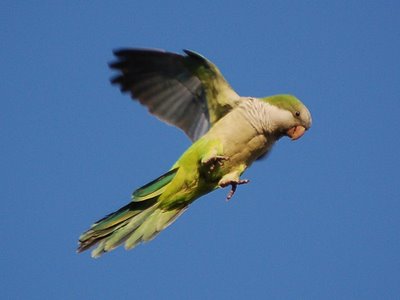
I looked up from the sidewalk to see a small spark of a bird dart out of a ditch and fly a few feet from my sweating face.
This wouldn’t have been noteworthy except for one small detail – the bird’s color. Instead of camouflaging its feathers to blend with a earth toned environment, the bird was bright green, like a crayon or piece of construction paper. Crossing the street, its wings flashed neon in a cardboard world.
Of course, I hold no prejudice against green birds. I believe all of God’s creatures should be proud of their heritage and display their colors without fear of drawing undue attention to themselves. It’s just that in most neighborhoods outside the Amazon, birds tend to be less flashy. Less exotic. Less green.
In Nashville, where I was running, we had many lovely blue birds, brown birds, red birds, and gray birds. We even enjoyed a few spectacular yellow finches. The only place in the Music City where you might find green birds, however, was at the zoo and on the Discovery Channel.
That’s why it was surprising, as I ran up a hill and into what I feared might be the beginning of cardiac arrest, when a wad of emerald feathers flashed across the sidewalk and into the great suburban wild of Nashville. I was certain the bird – a small fist-sized parrot – must have been an illusion, a figment of my sweating imagination. Had I suddenly tasted pennies or felt a tingling sensation in my left arm, the hallucination would have made much more sense and I might have expected to turn the corner and find myself running into a warm, white light.
But instead of a glowing end to my suffering, all I saw on the street was a rust red pick-up truck approaching on my right.
When you’re running and a truck passes going the opposite direction, you don’t have long to look through the windshield. Dolly Parton could drive past and you probably wouldn’t notice. But because the rust red truck was moving slower than it should have been, I had a few extra seconds to see the driver. Sitting behind the wheel was a sixty year old man, rough and unshaven, with gray hair, a red shirt, and a large green parrot perched on his right shoulder – the second parrot I had seen in the past two minutes.
With the exception of Jimmy Buffet – who lived in Nashville before he moved to Margaritaville – men in the Music City don’t generally wear parrots to work. In fact, the average Nashvillian knows as much about parrots as he does about recording contracts. Both are rumored to be real, but few have seen either in person.
After ten feet of careful consideration, I decided that the pirate trucker must have been driving through my neighborhood not because he wanted to spoil and plunder, but because he had a pet problem. It’s only a hunch based on unbelievable coincidence, but I think the pirate was the proud owner of not one, but two parrots - one lost, the other riding shotgun on his shoulder.
The parrot in the truck wasn’t simply along for the ride, tagging along to tell stories when the eight-track went out. It was being used as a zoological GPS to find the lost bird that crossed my path only moments before. The pick up pirate must have hoped that if birds of a feather really do flock together, he might be able to use this instinct to his advantage.
(I think it’s worth questioning whether a grown man should really trust directions squawked by an animal that has a vocabulary of only eight words, three of which are “cracker” and “pretty bird.” Personally, I wouldn’t. Of course, I don’t usually talk to anything that doesn’t have two external ears.)
It will forever remain a mystery as to why the little green spark flew away from home. Maybe he was tired of being served corn-nuts and Budweiser for breakfast. And while I will probably never know if the pick-up pirate was ultimately successful in his quest for the lost bird, I continue to be impressed by his effort. Finding a lost pet is never easy. At least when rounding up a runaway dog or searching for a lost cat, your pet’s hiding places are limited geographically by things like fences and streats. And gravity.
But when tracking a runaway parrot, there’s a tremendous amount of up to consider. The bird might be enjoying a bath in your neighbor’s backyard, or he might be eating french-fries with the parking-lot pigeons at Sonic. Or, if it hasn’t been fond of your brand of crackers, your bird might be on his way back to South America to teach a flock of its Brazilian cousins how to read the sports page in English. The sky is literally the limit.
As I rounded the corner, I glanced back to see the pirate’s truck turn left into a neighborhood filled with towering oaks and bushy maples. The Captain and his parrot sailed into the suburban jungle and I never saw them again. But on sunny days when the sidewalk calls, I still lace up my shoes and run. And I still sometimes wonder if the little green bird ever found its way home.
**
As a child I went through a stage of wanting to keep a bird as a pet. I was told, however, that it is both inhumane and inconvenient to keep a bird in a cage. Birds are born to fly free and cages are meant for naughty children who disobey their parents. Plus, depending on your political bias and opinion of the popular media, newspapers are intended to be read, not pooped upon. That’s why, in the redneck south, birds aren’t pets. Birds are target practice. Or dinner. Or both.
In Asian cultures a proverb says love is like a bird in a cage. If you love something, you set it free. If it comes back to you, it is yours forever. If it doesn’t, it was never yours to begin with.
In the Christian tradition, the bird is replaced with a sheep. The sheep is free to wander off – which it does – and is lost in the wilderness. Fortunately, in the traditional story, the shepherd is smarter than Little Bo Peep who lost her sheep and didn’t know where to find them. The shepherd knows his sheep and is convinced they are worth more than grilled kabobs and warm winter sweaters . . . so he leaves his flock to rescue the one who is lost.
And when he finds it, he joyfully carries it home where his friends and neighbors rejoice because the lost sheep is found.
During this season of Lent, I celebrate the shepherd Jesus. I am thankful that he is wise enough to know that love isn’t like a bird in a cage. If something you love runs away, you go after it no matter the cost.
Saturday, March 14, 2009
One in the Hand
Some people approach the new year like they approach a swimming pool in the spring, before the sun has really had time to share himself with the water. They step up to January first cautiously, poke one toe into the wintry water, and then decide that the only way they’ll survive the shock of a New Year is to dive head first into the deep. And so they take a breath and plunge into the New Year by making resolutions to change. To lose 100 pounds. To pay off all the credit cards. To learn Portuguese and read A Tale of Two Cities.
But what is it about the midnight between this year and the next that makes people decide they should make life altering resolutions? Why must we celebrate a new calendar year by buying a membership to a gym we’ll never use or spending ten torturous days dropping a smoking habit that we’ll be forced to find again in February? Why do we start our year with a maddening sprint when the finish line is still a long 365 days away? It just doesn’t make sense.
That’s why, when the New Year says jump, I don’t ask how high. I ask for how long and set the bar accordingly low. If I’m really going to commit an entire year to doing something that’s so unpleasant it requires a resolution, I at least want to know that I’m capable of finishing what I start. I like to set my New Year up for success by making bite sized changes that are small and easy to swallow.
For example:
One year I resolved to make my bed every morning. After 365 days of straightening my sheets, I finally realized how much more inviting it is to sleep in a bed that looks like it got dressed-up for the evening than it is to crawl into one that seems to have just wrestled a small goat. I liked the change so much I’ve made my bed every day since. Success.
The next year I committed that I would always hang my keys on the hook next to the front door instead of keeping them between the couch cushions or under my bed. I find that I’m much more punctual now and tend to swear less in the mornings. Success.
One year I told myself that I’d floss regularly. For the first three weeks of January I ate an unusual amount of corn-on-the-cob just to start the habit. This strategy met with mixed results. Literally.
I enjoy my manageable resolutions so much that several years ago I challenged myself to train for a marathon.
Three days a week I stretched my legs and laced my shoes, preparing my body to run its way through dehydration and heart attack. As anyone who has followed in these footsteps knows, whenever you attempt to run any mile number greater than your shoe size, death always feels approximately one breath away.
Although running carries with it both positive and excruciating side effects, it really is a wonderful way to learn your neighborhood. When you run, not only do you burn calories and exercise your heart, but you also see a snapshot of the people who share your sidewalk and your mailman.
For example:
When I ran the ten mile loop around and through my Nashville neighborhood, I often passed a thirteen year-old boy at the corner of mile three. I saw him only on colder days, but I think the boy wore his hood pulled up more for attitude than for warmth. He never smiled, and I learned that I shouldn’t either. Instead, when we meet on the sidewalk, we frowned coolly at each other and raised our chins in a sort of cranial wave. I assumed this meant hello, but considering the neighborhood it might have also been the boy’s way of telling me his pockets were filled with smokeable plants that he was “holding for a friend.”
If the boy’s nod was some sort of subtle sales pitch, I hope he takes a marketing class when/if he gets to High School. The boy obviously has no idea of how to recognize his target consumer. Trying to sell weed to jogger is like trying to sell a bikini to a nun . . . in December.
I also occasionally saw a man I called “Cross Country.” When he ran, Cross Country looked as if he was concentrating, like his mind was thinking about things like form and balance and breathing, like his brain had to focus to control his body. Until I began training for the marathon, I had no idea running was so complicated. I thought it was simply an evolution of walking that we all learned when we were toddlers and our cholesterol had not yet awoken.
When he jogged past me, Cross Country never nodded to acknowledge that we were both sweating through the same sadistic ritual. He ran in his own world, and no one else was invited. Cross Country wore special shirts that were loose and synthetic and probably designed to recycle his sweat and prevent dehydration. Not me. I wore pre-stained shirts bought from the bargain bin at Goodwill. They were 100% cotton and advertised everything from credit cards to Christian camps. They also retained water like a pregnant woman.
Some people like to run with partners or groups so they can encourage each other along the way. But what is there to say while you’re running except “help,” “oh God,” and “glycerine”? When I run, I don’t want to be encouraged. I want to be alone. Sometimes I don’t even listen to music. Although I like the distraction of music, I get mad at the singers for breathing so easily.
Once, however, I was running up the hill that marked mile eight when I passed a fellow jogger who smiled and shouted “That’s right! Good job!” as he reached out his hand and gave me five. At the time I was so busy needing something actual like oxygen that I didn’t feel the need for something abstract like five. To my surprise, however, an encouraging slap from a stranger was exactly what I needed to finish the last two miles. When I collapsed exhausted in front of my house, I repeated his words “That’s Right” and “Good Job” just before I threw-up.
Then, one afternoon, just after I passed the hooded boy and shortly before my encounter with Cross Country, my heart and iPod were each thumping their own separate rhythms when a homeless man stepped into the sidewalk fifty feet in front of me. The man looked confused and unsteady, like someone who has just rolled out of bed and is still uncertain of how to start his day.
In my mind, I called him Oscar.
I gave the homeless man this name not because of his unusual aroma or wild, discolored hair. I didn’t call him Oscar because he was green or because I had ever seen him associate with a Cookie Monster, Big Bird, or Mr. Snuffleupagus. In fact, I don’t think there was a Sesame Street anywhere near my house. I called the man Oscar because of his unpleasant personality and half-empty attitude.
Oscar was a grouch.
After climbing over the curb and into my path, Oscar stood in the sidewalk silently watching the cars pass. He looked left. He looked right. And when Oscar finally turned toward me, made eye contact, and raised his right hand, I smiled, preparing to wave and say hello as we passed, pleased that I was making a new friend.
It soon became clear, however, that Oscar wasn’t interested in becoming friends. If he had been, his raised hand would have been opened in a gesture of welcome and brotherhood. But it wasn’t. His hand was almost entirely closed. Except for one lone finger.
Fortunately, since the middle finger is the tallest of all the fingers, it can be most easily seen from the farthest away. Even at fifty feet I knew exactly what Oscar was trying to say, and it wasn’t hello.
(As a child, I often played checkers with my grandfather. We called him Granddaddy Jack, but I’m not sure why. His first name was Harvey and his second name was Lee. We called him Jack because that’s how he was known to everyone in the small town of Trenton, Tennessee where he lived - but I don’t think anyone in Trenton knew why he was called Jack either.
I liked to play checkers with my Granddaddy Jack because he had style. When we sat down to play, Grandaddy Jack didn’t move the checker with his pointer finger like I did. Instead, he always used his long middle finger . . . his “bad finger” . . . the finger tough kids on the playground used when they were angry . . . the finger that got you sent to your room without any dinner if you used it while you were shouting at your sister. Granddaddy Jack was a deacon in his church and a man of great integrity. He never got in trouble on the playground and probably had no idea why I giggled every time he moved his checker.)
Oscar began his unfriendly gesture when we were still a staggering fifty feet apart. As I ran toward him, the grouch and I stared at each other for every bit as long as it has taken you to read this story. I’m not a very fast runner. And for each of those seventy-five awkward steps, Oscar’s finger stood in its lonely salute as a testimony to his feelings for me. He and his finger hated me for fifty feet. It was like watching a Peter Jackson movie or reading Tolstoy or listing to Queen’s almost six minute Bohemian Rhapsody. Oscar’s grouchy middle finger took a simple message and turned it into an epic statement.
I would like to think that Oscar was like my Granddaddy Jack and was simply using his middle finger for some innocent and utilitarian purpose. Maybe he was checking the wind or letting his nail polish dry. But I don’t think so. Oscar didn’t seem like the nail polish type.
But because I try to see the best in other people, I choose to believe that when Oscar raised his finger that day, he had the best of intentions. He probably meant to give me five and simply forgot the other four. I understand. I’m not very good at math either.
That’s why, when we passed, I decided that Oscar didn’t need something actual like income. He needed something abstract like encouragement. And so, instead of ignoring him or saying something unkind and trotting by in a sweaty blur, I acknowledged Oscar’s finger with a smile, gave him five, and cheerfully said “That’s Right! Good Job!”
And then I finished my last mile, happy to be a bright spot in someone’s day.
But what is it about the midnight between this year and the next that makes people decide they should make life altering resolutions? Why must we celebrate a new calendar year by buying a membership to a gym we’ll never use or spending ten torturous days dropping a smoking habit that we’ll be forced to find again in February? Why do we start our year with a maddening sprint when the finish line is still a long 365 days away? It just doesn’t make sense.
That’s why, when the New Year says jump, I don’t ask how high. I ask for how long and set the bar accordingly low. If I’m really going to commit an entire year to doing something that’s so unpleasant it requires a resolution, I at least want to know that I’m capable of finishing what I start. I like to set my New Year up for success by making bite sized changes that are small and easy to swallow.
For example:
One year I resolved to make my bed every morning. After 365 days of straightening my sheets, I finally realized how much more inviting it is to sleep in a bed that looks like it got dressed-up for the evening than it is to crawl into one that seems to have just wrestled a small goat. I liked the change so much I’ve made my bed every day since. Success.
The next year I committed that I would always hang my keys on the hook next to the front door instead of keeping them between the couch cushions or under my bed. I find that I’m much more punctual now and tend to swear less in the mornings. Success.
One year I told myself that I’d floss regularly. For the first three weeks of January I ate an unusual amount of corn-on-the-cob just to start the habit. This strategy met with mixed results. Literally.
I enjoy my manageable resolutions so much that several years ago I challenged myself to train for a marathon.
Three days a week I stretched my legs and laced my shoes, preparing my body to run its way through dehydration and heart attack. As anyone who has followed in these footsteps knows, whenever you attempt to run any mile number greater than your shoe size, death always feels approximately one breath away.
Although running carries with it both positive and excruciating side effects, it really is a wonderful way to learn your neighborhood. When you run, not only do you burn calories and exercise your heart, but you also see a snapshot of the people who share your sidewalk and your mailman.
For example:
When I ran the ten mile loop around and through my Nashville neighborhood, I often passed a thirteen year-old boy at the corner of mile three. I saw him only on colder days, but I think the boy wore his hood pulled up more for attitude than for warmth. He never smiled, and I learned that I shouldn’t either. Instead, when we meet on the sidewalk, we frowned coolly at each other and raised our chins in a sort of cranial wave. I assumed this meant hello, but considering the neighborhood it might have also been the boy’s way of telling me his pockets were filled with smokeable plants that he was “holding for a friend.”
If the boy’s nod was some sort of subtle sales pitch, I hope he takes a marketing class when/if he gets to High School. The boy obviously has no idea of how to recognize his target consumer. Trying to sell weed to jogger is like trying to sell a bikini to a nun . . . in December.
I also occasionally saw a man I called “Cross Country.” When he ran, Cross Country looked as if he was concentrating, like his mind was thinking about things like form and balance and breathing, like his brain had to focus to control his body. Until I began training for the marathon, I had no idea running was so complicated. I thought it was simply an evolution of walking that we all learned when we were toddlers and our cholesterol had not yet awoken.
When he jogged past me, Cross Country never nodded to acknowledge that we were both sweating through the same sadistic ritual. He ran in his own world, and no one else was invited. Cross Country wore special shirts that were loose and synthetic and probably designed to recycle his sweat and prevent dehydration. Not me. I wore pre-stained shirts bought from the bargain bin at Goodwill. They were 100% cotton and advertised everything from credit cards to Christian camps. They also retained water like a pregnant woman.
Some people like to run with partners or groups so they can encourage each other along the way. But what is there to say while you’re running except “help,” “oh God,” and “glycerine”? When I run, I don’t want to be encouraged. I want to be alone. Sometimes I don’t even listen to music. Although I like the distraction of music, I get mad at the singers for breathing so easily.
Once, however, I was running up the hill that marked mile eight when I passed a fellow jogger who smiled and shouted “That’s right! Good job!” as he reached out his hand and gave me five. At the time I was so busy needing something actual like oxygen that I didn’t feel the need for something abstract like five. To my surprise, however, an encouraging slap from a stranger was exactly what I needed to finish the last two miles. When I collapsed exhausted in front of my house, I repeated his words “That’s Right” and “Good Job” just before I threw-up.
Then, one afternoon, just after I passed the hooded boy and shortly before my encounter with Cross Country, my heart and iPod were each thumping their own separate rhythms when a homeless man stepped into the sidewalk fifty feet in front of me. The man looked confused and unsteady, like someone who has just rolled out of bed and is still uncertain of how to start his day.
In my mind, I called him Oscar.
I gave the homeless man this name not because of his unusual aroma or wild, discolored hair. I didn’t call him Oscar because he was green or because I had ever seen him associate with a Cookie Monster, Big Bird, or Mr. Snuffleupagus. In fact, I don’t think there was a Sesame Street anywhere near my house. I called the man Oscar because of his unpleasant personality and half-empty attitude.
Oscar was a grouch.
After climbing over the curb and into my path, Oscar stood in the sidewalk silently watching the cars pass. He looked left. He looked right. And when Oscar finally turned toward me, made eye contact, and raised his right hand, I smiled, preparing to wave and say hello as we passed, pleased that I was making a new friend.
It soon became clear, however, that Oscar wasn’t interested in becoming friends. If he had been, his raised hand would have been opened in a gesture of welcome and brotherhood. But it wasn’t. His hand was almost entirely closed. Except for one lone finger.
Fortunately, since the middle finger is the tallest of all the fingers, it can be most easily seen from the farthest away. Even at fifty feet I knew exactly what Oscar was trying to say, and it wasn’t hello.
(As a child, I often played checkers with my grandfather. We called him Granddaddy Jack, but I’m not sure why. His first name was Harvey and his second name was Lee. We called him Jack because that’s how he was known to everyone in the small town of Trenton, Tennessee where he lived - but I don’t think anyone in Trenton knew why he was called Jack either.
I liked to play checkers with my Granddaddy Jack because he had style. When we sat down to play, Grandaddy Jack didn’t move the checker with his pointer finger like I did. Instead, he always used his long middle finger . . . his “bad finger” . . . the finger tough kids on the playground used when they were angry . . . the finger that got you sent to your room without any dinner if you used it while you were shouting at your sister. Granddaddy Jack was a deacon in his church and a man of great integrity. He never got in trouble on the playground and probably had no idea why I giggled every time he moved his checker.)
Oscar began his unfriendly gesture when we were still a staggering fifty feet apart. As I ran toward him, the grouch and I stared at each other for every bit as long as it has taken you to read this story. I’m not a very fast runner. And for each of those seventy-five awkward steps, Oscar’s finger stood in its lonely salute as a testimony to his feelings for me. He and his finger hated me for fifty feet. It was like watching a Peter Jackson movie or reading Tolstoy or listing to Queen’s almost six minute Bohemian Rhapsody. Oscar’s grouchy middle finger took a simple message and turned it into an epic statement.
I would like to think that Oscar was like my Granddaddy Jack and was simply using his middle finger for some innocent and utilitarian purpose. Maybe he was checking the wind or letting his nail polish dry. But I don’t think so. Oscar didn’t seem like the nail polish type.
But because I try to see the best in other people, I choose to believe that when Oscar raised his finger that day, he had the best of intentions. He probably meant to give me five and simply forgot the other four. I understand. I’m not very good at math either.
That’s why, when we passed, I decided that Oscar didn’t need something actual like income. He needed something abstract like encouragement. And so, instead of ignoring him or saying something unkind and trotting by in a sweaty blur, I acknowledged Oscar’s finger with a smile, gave him five, and cheerfully said “That’s Right! Good Job!”
And then I finished my last mile, happy to be a bright spot in someone’s day.
Thursday, March 5, 2009
Slippery Squirrels

I'm not sure why my mom hates squirrels, but I think it started with popcorn.
In an age before coaxial cable wired HBO and Showtime directly into televisions across the United Sates, the first VCRs found their way into suburban living rooms when I was in elementary school. Prior to the VCR, if you wanted to watch a movie you were forced to either see it in the theater or wait ten years until a highly edited version was shown on one of the three network channels your family’s television was able to tune-in. The houses of my childhood looked like giant bricked insects with aluminum antenna mounted on their backs. TV Guide was much thinner.
The idea of preserving video on cassette tape revolutionized the free time of an already television addicted generation. The new VCR recorded our favorite shows and gave children the freedom to go to the bathroom sometime other than during commercial breaks. It allowed us to pause, rewind, and skip the boring parts of programs we taped while we watched the Cosbys settle this week’s crisis or the Miami Vice keep Florida crime free. The VCR helped us memorize favorite jokes and imitate the characters who were live on Saturday night. It let us watch any movie any time we wanted to. It did for cinema what reruns had already done for television. It gave us a second chance.
I’m convinced that both the newly invented VCR and its accomplice, the video rental store, were also ultimately responsible for the great squirrel invasion of 1986.
One particularly warm summer night my parents piled my sister and I into the family station wagon and drove us to the new local video store to see what blockbusters it might offer as entertainment for the evening. As always, the choices were so overwhelming that Kathy and I argued over what we would watch. I wanted to rent an action move. She wanted a drama. I wanted to laugh. She wanted to cry. It wasn’t until we remembered that a boy named Ferris Bueller had recently narrated an entire movie about how to take the perfect day off that we reached a compromise: I would rent the movie about the kid who knew karate, my sister would watch Molly Ringwald blow out her sixteen candles, and we would both enjoy learning from Ferris, Cameron, and Sloane the fine art of skipping school.
After a night of watching movies and popping popcorn, Kathy and I were cleaning the living room when my mom noticed a few handfuls of popcorn left in the bottom of the bowl. Before we could put the uneaten corn in the trash she said, “instead of throwing that popcorn out, you guys should toss it in the backyard for the birds to eat. Wouldn’t that be fun?”
At the time, the idea of throwing leftover food in the backyard for birds to eat seemed both indecent and exotic. My family usually put its leftovers either in Tupperware or in the trash. We never threw them in the yard. But since Jesus didn’t seem to get too upset when his five thousand friends left a bit of stale bread littering a rural hillside, we decided that tossing a few kernels of popcorn in the backyard might not be such a bad idea after all.
Feeding the birds with our table scraps quickly became a game for my sister and I. For several weeks after the first popcorn feeding, when my mom baked biscuits or made cornbread for dinner, Kathy and I fought for who would win the right to crumble and scatter the uneaten bread across the yard. Although the project was really less about feeding hungry animals than it was about making our backyard look cheerful and charitable, the birds loved our homemade treats, and we were convinced they loved us for providing them. Our backyard soon became a bird buffet with loyal customers ranging from blue jays and cardinals to robins and redbirds.
We eventually graduated from feeding the birds discarded popcorn and biscuits to using an actual birdfeeder. Our first one looked like a little pine house on a pole. Its clear plexiglass sides let potential diners see what kind of seed we were serving for dinner, and we soon found the birds were just as happy with convenience food as they had been with home cooking.
The cardinals enjoyed a diet rich in sunflower seeds while the doves and finches ate lots of wheat. Thistle seed was a favorite of the goldfinches. The mockingbirds, blue birds, robins, and woodpeckers enjoyed dried fruit in the feeder. For the sparrows, we bought lots of millet. When you consider their diet, it’s really not surprising that birds have become infamous for giving a sh** where others dare not.
Although our intent had always been to feed the birds, squirrels apparently enjoy bird seed as much as birds do. And since birds tend to be fairly messy eaters, they usually supplied the squirrels in our yard with a fairly constant rain of castoff sunflower seeds and millet to supplement the thousands of acorns already littering our yard.
I would like to think that that most creatures who can’t enjoy the luxury of large franchised supermarkets would be content with free food raining from the sky. Our squirrels, however, were smart enough to understand that the shower of seed raining from above was coming from somewhere other than heaven, and they wanted to know where that somewhere was. When the first squirrel championed an expedition up the birdfeeder pole and found a small wooden house full of food at its summit, he knew his days of foraging and hoarding were over.
In the frenzied seconds that followed, the air in our backyard grew thick with fur and flying seed. Until I witnessed the squirrel’s appalling table manners, I never imagined that animals could binge eat. It was a Jenny Craig nightmare. In less than a minute, a single squirrel emptied our entire birdfeeder of its contents. While some of the seed must have found its way into the squirrel’s small mouth, most of it flew like Cookie Monster crumbs across the yard and was quickly collected by the squirrel’s waiting (and grateful) friends.
My mother was mortified. After months of enabling the birds with a steady diet of ever-available seed, she was convinced they would no longer be able to survive in the worm-eating world. Thanks to the selfish squirrels, she said, our backyard birds were going to bed hungry.
And so began our quest to protect the birds and keep the squirrels out of our birdfeeder.
Plan A:
Our first anti-squirrel experiment involved a cone that was attached midway up the birdfeeder pole with its open side down. The cone made our birdfeeder look like a skinny one-legged girl wearing an aluminum dress. In theory, the hungry squirrels would climb half-way up the pole, reach a dead end, turn around, and give up. Unfortunately, our squirrels either didn’t think the birdfeeder’s new outfit made it look like an underfed supermodel, or they were terribly immodest. Not only did the squirrels continue to climb up the birdfeeder’s one long leg, but they also found a way past her shiny aluminum skirt and into her feed box, where they eagerly scattered their seed.
Who could blame us for our outrage?
Plan B:
Because, as natural climbers, the squirrels would always find a way up the birdfeeder pole, the next logical solution was to eliminate the pole altogether. If the birdfeeder could somehow be suspended in midair, the squirrels would be forced to wait for evolution to grant them the gift of flight before they could steal our seed. And since evolution is notoriously slow, hanging the birdfeeder above the ground seemed like a marvelous idea.
After three trips up a stepladder, a tightrope of clothesline cord was strung between two trees with the birdfeeder dangling from its middle. Unwilling to wait for wings, however, the squirrels decided to attack from the trees. Two hours after we hung the birdfeeder, a squadron of squirrels dove from the branches, landing on the birdfeeder’s roof and swinging it until every seed had been thrown from its hold. The troops waiting below devoured the seed in moments, eating it off the ground and picking crumbs from each other’s fur.
Until that spring, I never considered that birdseed is actual seed, but it is. And like all seed, it grows. April showers usually bring May flowers, but by June our yard grew more than daisies and tulips. Thanks to the squirrels and their seed scattering, the spring rain of 1986 transformed our backyard into a half acre of suburban farmland.
While our neighbors’ yards grew dandelions, ours sprouted sunflowers. While other neighborhood dads tried to keep their crab grass under control, mine fought a backyard full of summer wheat. And as the squirrels continued to sow their seed, I became increasingly aware that I had somehow transitioned from mowing the yard every Saturday to harvesting it.
Plan C:
My Uncle Frankie, the Peter Pan of our clan, devised a plan to eliminate our squirrel problem that involved a five gallon tub of Crisco and a pair of latex gloves.
Although we should have known better than to play along with whatever Neverland game my uncle’s imagination had invented, we didn’t. Instead, we followed Uncle Frankie’s advice and smeared handfuls of shortening along the length of our birdfeeder pole.
Uncle Frankie claimed that this homemade slippery pole would make it impossible for squirrels to climb all the way to the birdfeeder above. They might make it half-way, but the combined forces of gravity and whipped vegetable fat would ensure the birdseed’s safety. He personally guaranteed that the Crisco pole could be conquered by not even the most persistent squirrel. Climbing it would be impossible, like climbing a stick of butter.
Uncle Frankie was right. The Crisco pole was an unparalleled success and as entertaining as it was effective. A few ambitious squirrels made impressive attempts at climbing the greased pole, but after four lubricated feet their exhausted arms lost their grip and they inevitably slid slowly back down like small, greasy firemen.
(The whole scene was reminiscent of that torturous day in jr. high gym class when the girls were moved to one end of the gym to play kick-ball while the guys were herded to the opposite corner and told to climb a giant rope hanging from the rafters. For some unknown reason, gym teachers always wanted us to climb the rope, as if this was a life-skill that boys were required to master before adulthood. Didn’t our gym teachers understand that most modern buildings are equipped with both stairs and elevators? Unless your career goals include becoming a pirate, I could never think of a single job that would require a grown man to climb a rope on his way to the office. And yet, they still made us climb.)
After several unsuccessful hours trying to pillage the birdfeeder, the poor squirrels sat at the bottom of the pole, spent and frustrated, licking the Crisco off their paws. Since squirrels generally survive on nuts, berries and the occasional high fiber-bug, their small bodies aren’t accustomed to an un-cut Crisco diet. And so, thanks to both my Uncle Frankie’s brilliant plan and my family’s blind obedience, our yard was quickly filled with the fattest squirrels ever seen in the wild.
At the end of a long day of pole climbing, when the greasy squirrels finally summoned enough energy to drag themselves back home, tree branches creaked and groaned under their pot-bellied weight. The summer was particularly harsh as several of the cat-sized squirrels baked to a golden greasy brown in the hot August sun.
**
More than two decades have passed since the great squirrel invasion of 1986, and its final moments have been lost to memory. All we know for sure is that what began with the Hansel-and-Gretel-like innocence of children dropping crumbs in their backyard quickly degenerated into a Crisco-covered mess.
Family lore doesn’t record who finally won the battle or how. But as we laugh over the story during countless Thanksgiving dinners, my mother continues to defend her actions. She says she simply hoped that if we put the food just out of the squirrels’ reach for long enough, maybe they’d get frustrated – maybe they’d give up and go away.
Not long after our backyard conflict was resolved, a more significant family battle began that eventually caused my parents to divorce each other and re-marry other people. When I was a senior in high-school my mom met and married a wonderful man named Bob and together they moved into a home that wasn’t haunted with memories of slippery squirrels and starving birds. The hummingbird feeders that now hang in their kitchen window are filled with sugar water. While these feeders attract the occasional winged insect, they are never fought over by anything larger than a bumble-bee.
Unfortunately, at her new house my mom is now doing battle with another rodent foe. A family of chipmunks has invaded the yard and is threatening my mother’s sanity. She and Bob have approached this new challenge with very different strategies. Bob is a kind and gentle man who has attempted to re-habilitate the chipmunks in an unsuccessful catch-and-release program. My mother prefers a more aggressive approach. She wants to adopt a hungry cat.
My Uncle Frankie has a brilliant solution to the chipmunk problem that involves steel wool and peanut butter, but we don’t listen to him much anymore.
Wednesday, February 11, 2009
Christmas in Five Acts
I realize that Christmas 2008 was thrown out with the wrapping paper almost two months ago. But as many of you know, the last year has been . . . well, transitional. Chaotic. Hopefully you’ll forgive me for posting an out-of-season story that I’ve only just finished. If you do, I’ll forgive you for wearing white after Labor Day. -b
Act 1. The Problem:
Even though the last days of December are already hectic for both Santa and Jesus, I thought it was appropriate to tell history's two most popular people what happened. Since neither seems overly concerned with justice, I feel it's necessary for someone to help them update their naughty lists during the busy season.
Of course, I don't fault them with what happened. I understand that neither Jesus nor his party planner spend much time watching locker rooms at the YMCA - especially at Christmas. To do so would almost certainly be a violation of the omniscience that has made them each famous.
But that doesn't excuse the fact that I was robbed.
Act 2. The Setting:
My sister’s Christmas tree was spectacular, planted in a mulch of ribbons and wrapping paper, blooming with a hundred colored bulbs. Angels and snowmen nested in branches drooping with a harvest of fragile glass balls. The poor thing should have been the happiest tree on earth.
Kathy is a good mother. She waters her children regularly. They're so hydrated they sometimes leak at night. She even gives Santa, who only stops by for a few minutes each year, a glass of warm milk and cookies. The Christmas tree, however, endured its three week stay in my sister's house without her offering it the smallest sip of water.
For all its decoration, the tree might as well have been a princess parading through a dessert - dressed for a banquet, but dying of thirst. Parched, it probably spent the entire Christmas season wondering how an eight foot evergreen transplanted to a suburban living room and covered with flashing lights could possibly be forgotten by a family of four.
Sadly, it happens – especially at Christmas.
Act 3. The Situation:
Children’s minds get cluttered at Christmas. At least twice during the holidays they need to have their brains washed to clear the visions of sugarplums out of their heads. Bloody slasher movies do the trick, but most parents prefer things like playgrounds, trampolines, bike rides, and basketball.
Four days before Christmas, Kathy told her kids that they were going to the swimming pool and Uncle Bryan was coming too. The Children cheered and changed their clothes. The Christmas tree sighed.
“Mammals,” it thought, “have all the fun.”
It was right. Four days before Christmas, we went swimming.
Act 4. The Stupidity
Does Santa lock his sleigh so kids out after curfew don’t swipe his pack of smokes off the passenger seat?
Did Mary lock the manger door to keep loitering shepherds from stealing her family’s new stash of gold, frankincense, and myrrh?
Do the elves lock their toys in a trunk every time the Tooth Fairy comes for a visit?
No. Of course not.
In a similar spirit of blissful trust and unintentional generosity, when we went to the pool I didn’t lock my locker.
Act 5. The Scandal:
The kids who stole my cash didn't care if Santa watched when they were sleeping. According to a Christmas carol loophole, by day he only knew they were awake.
If the details of their waking lives, and therefore their hopes for a coal-free Christmas morning, were protected by this technicality – why shouldn't they help themselves to the contents of a stranger's wallet?
Answer: Even if he wasn't watching when they opened my locker door, Santa will see the aspiring young convicts at the mall next year. When he does, he'll wonder where they got the money to buy those new shoes he wasn't asked to make and he'll know why they no longer need his services.
So don’t forget, little thieves, your name never gets crossed off his list. It only gets moved to a different column. This is where the two Christmas patriarchs part company. Santa holds a grudge.
Act 1. The Problem:
Even though the last days of December are already hectic for both Santa and Jesus, I thought it was appropriate to tell history's two most popular people what happened. Since neither seems overly concerned with justice, I feel it's necessary for someone to help them update their naughty lists during the busy season.
Of course, I don't fault them with what happened. I understand that neither Jesus nor his party planner spend much time watching locker rooms at the YMCA - especially at Christmas. To do so would almost certainly be a violation of the omniscience that has made them each famous.
But that doesn't excuse the fact that I was robbed.
Act 2. The Setting:
My sister’s Christmas tree was spectacular, planted in a mulch of ribbons and wrapping paper, blooming with a hundred colored bulbs. Angels and snowmen nested in branches drooping with a harvest of fragile glass balls. The poor thing should have been the happiest tree on earth.
Kathy is a good mother. She waters her children regularly. They're so hydrated they sometimes leak at night. She even gives Santa, who only stops by for a few minutes each year, a glass of warm milk and cookies. The Christmas tree, however, endured its three week stay in my sister's house without her offering it the smallest sip of water.
For all its decoration, the tree might as well have been a princess parading through a dessert - dressed for a banquet, but dying of thirst. Parched, it probably spent the entire Christmas season wondering how an eight foot evergreen transplanted to a suburban living room and covered with flashing lights could possibly be forgotten by a family of four.
Sadly, it happens – especially at Christmas.
Act 3. The Situation:
Children’s minds get cluttered at Christmas. At least twice during the holidays they need to have their brains washed to clear the visions of sugarplums out of their heads. Bloody slasher movies do the trick, but most parents prefer things like playgrounds, trampolines, bike rides, and basketball.
Four days before Christmas, Kathy told her kids that they were going to the swimming pool and Uncle Bryan was coming too. The Children cheered and changed their clothes. The Christmas tree sighed.
“Mammals,” it thought, “have all the fun.”
It was right. Four days before Christmas, we went swimming.
Act 4. The Stupidity
Does Santa lock his sleigh so kids out after curfew don’t swipe his pack of smokes off the passenger seat?
Did Mary lock the manger door to keep loitering shepherds from stealing her family’s new stash of gold, frankincense, and myrrh?
Do the elves lock their toys in a trunk every time the Tooth Fairy comes for a visit?
No. Of course not.
In a similar spirit of blissful trust and unintentional generosity, when we went to the pool I didn’t lock my locker.
Act 5. The Scandal:
The kids who stole my cash didn't care if Santa watched when they were sleeping. According to a Christmas carol loophole, by day he only knew they were awake.
If the details of their waking lives, and therefore their hopes for a coal-free Christmas morning, were protected by this technicality – why shouldn't they help themselves to the contents of a stranger's wallet?
Answer: Even if he wasn't watching when they opened my locker door, Santa will see the aspiring young convicts at the mall next year. When he does, he'll wonder where they got the money to buy those new shoes he wasn't asked to make and he'll know why they no longer need his services.
So don’t forget, little thieves, your name never gets crossed off his list. It only gets moved to a different column. This is where the two Christmas patriarchs part company. Santa holds a grudge.
Tuesday, February 3, 2009
Close Enough
Everybody has an airport story – that excruciating tale of waiting on the runway for four hours that's unique to everyone we know.
They’re among our favorite stories to tell because we’ve rehearsed them so often, perfected their timing and developed their characters. We can perfectly describe both the woman who filled two seats in row three and the man who somehow lost his barf bag. During each of our repeat performances, we remain confident that nobody can compare turbulence to a roller coaster quite like we can. Our accounts typically begin with subtle and understated openings like, “Not long ago I had to fly to . . .” and end with the self-conscious clincher, “well, it was just terrible.”
We usually tell these stories at parties, not because they’re particularly interesting or original, but because someone else opens the door with their own travel nightmare. And even though everyone in the kitchen is bored with the subject as soon as they’ve told their own tale, we’re convinced they’re still listening on the edge of their seats, sitting in an upright and locked position while we finish a monologue about our luggage being lost.
“Well,” we say, “it was just terrible.”
And by the time we’ve finished talking, everyone agrees. That really was just terrible.
**
After a recent trip to visit my family in Nashville, I was scheduled to land at New York’s LaGuardia airport. Half-way through the flight, 40,000 feet over impending doom, the pilot made the following announcement:
“Excuse me ladies and gentlemen. Please pardon the interruption, but we’re experiencing a few technical difficulties we’d like to make you aware of. Don’t worry, there’s nothing wrong with the plane. But our brakes don’t seem to be working . . . “
Being a man of words, I quickly applied an editorial ear to this announcement and gleaned the following key phrases. One of them feels a bit conspicuous, like it doesn’t belong with the others. You have to bend its corners to make it fit. Can you guess which one?
1. We’re experiencing technical difficulties
2. There’s nothing wrong with the plane
3. Our brakes don’t seem to be working
If we’re (1) experiencing technical difficulties and our (3) brakes don’t seem to be working, then it logically follows that there is something wrong with the plane. Feeding a metal tube full of passengers that small spoonful of sugar does not help the medicine go down.
I wonder if the captain of the Titanic, the pilot of the Hindenburg, or any of the Space Shuttle Challenger crew ever started a speech with “there’s nothing wrong with our ship, but...”
Consider a mother panda telling her tear stained daughter, “sweetheart, there’s no need to worry. We’re not going extinct... but there’s a reason you don’t have any friends.”
Or Santa mentioning during a staff meeting, “you all know that global warming is a complete ho-ho-hoax... but I was thinking that maybe we should make our uniforms with shorter sleeves next year.”
Or a Native American man saying to his son, “the nice white people said they don’t want our land... but if you were going to pack your four favorite things into a box, which four things would you choose?”
The “but” serves the same purpose in these speeches as it does on the human body. It’s just fleshy nonsense that does nothing but cushion an impending blow to your backside.
After the announcement, a wave of quiet panic swept through the cabin. The woman filling two seats in aisle three tightened her already strained seatbelt. A man holding a curious smelling sack excused himself from row twelve. While most of the passengers wondered why oxygen masks hadn’t already fallen from the ceiling, the passenger sitting in my seat wondered how the pilot discovered our brakes weren’t working.
Did he tap the left pedal and notice a sluggish response? Considering that objects in motion tend to stay in motion, would that really be cause for alarm? I suspect that driving a 400 ton passenger jet is not unlike managing a nuclear conflict – once it’s started, it’s probably difficult to stop – and for good reason. Principals like inertia, momentum, and gravity dictate that stopping suddenly at several thousand feet is an exceptionally bad idea. To be no longer moving forward is to be quickly moving downward. Stories of airplanes stopping suddenly usually end with words like “crash” and “tragedy.”
The pilot, however, wanted us to stop not immediately, but sometime shortly after reaching the airport. Unfortunately, the airport was as much of a problem as our broken airplane. The runways at New York’s LaGuardia Airport are apparently too short for a 400 ton jet hitting the ground at 160 mph to stop using only its emergency brakes. Errant planes at LaGuardia coast off the end of the pavement and drop into the East River, never to be seen again.
In an effort to save 200 passengers the trouble of using their seat cushions as flotation devices, our pilot radioed the tower and requested that our flight be re-routed to New York’s JFK airport, where the runways are longer and don’t force emergency brakes to work under such impossible deadlines.
Geographically, the change wasn’t significant. It wasn’t as if LaGuardia closed unexpectedly and forced planes to land in Los Angeles, 3000 miles away. Our flight was simply re-routed from one side of the city to the other. Only twelve miles apart, LaGuardia and JFK are as close to each other as a person’s elbows are to his knees. The same taxis, trains and shuttles connect them both to New York’s mid-section, home to the city’s Empire State Belly Button – one of the largest outies in the world.
Despite our broken brakes, several passengers seemed concerned not that we might experience a rough landing, but that the inflatable slide might dump us out at the wrong airport.
A college student pressed her call button and asked the already frazzled stewardess, “But what about our luggage? I mean, how are we supposed to get our bags?”
The stewardess paused and inhaled deeply through her nose. “The pilot thought it would be best if we all arrived together,” she said, “so he had your luggage re-routed to JFK as well.”
“Oh,” the girl said. “good.”
**
When our plane finally bumped onto the runway, several people jerked awake from long in-flight naps. They wondered why their fellow passengers applauded and cheered when the plane finally pulled to a stop. Were the lights and sirens escorting us down the runway celebrating ours as the one-millionth landing? Would there be prizes? Would we each be awarded a free membership in the mile-high club?
As old men stretched and young women collected their belongings, the pilot made his second big announcement of the evening. First he confirmed that we had just landed safely at JFK, stopping well before the end of the runway. He then announced that the airline had arranged for a shuttle to take us to LaGuardia.
A few tourists smiled, obviously believing this was good news.
The rest of us wondered, why would we ride a crowded bus to LaGuardia when for $2 the subway will take us from here to anywhere we want to go?
“Must we take the shuttle,” a passenger asked. “Will it be possible to retrieve our luggage and leave from here?”
“No,” came the reply. “According to FAA regulations, all luggage must be loaded onto the new airplane that will fly us to LaGuardia.”
Airplane? Fly? Had the airline that charged $25 for each of our bags and would soon deny us a small cup of free soda really arranged for an airplane to fly us the final 12 miles to LaGuardia?
According to the pilot whom we applauded only moments before, the answer was yes. He assured us, however, that this would be a relatively simple process:
As soon as our replacement plane landed (45 minutes) and it’s passengers unloaded (20 minutes), the cabin would be cleaned (15 minutes) and our luggage would be transferred while we re-boarded the new plane (30 minutes). We would then wait for clearance to take off (25 minutes) before we flew the final 12 miles to LaGuardia.
In other words, it would take the new airplane over two hours to shuttle us 12 miles.
A handicapped toddler could carry our luggage to LaGuardia faster than that.
This news raised the terror alert on our flight from an ever-present orange to a more realistic red. Even the love-starved co-ed with a boyfriend waiting at the wrong airport threatened to join our mutiny against the shuttle. In our solidarity, we would not allow the airline to hold our luggage hostage. We would not fall victim to their ill-conceived customer service. We would not add two needless hours to this already nightmarish trip.
Like Moses and Martin Luther King, Jr., we fought for our freedom.
“We have a right to ride the subway,” we cried.
“You can’t force us to the back of a bus!”
“Let our luggage go!”
When a stewardess started to cry, however, everything settled down quite a bit.
In reality, the angry passengers who complained did it mostly to each other. Their shouts were little more than the mumblings of tired and passive-aggressive passengers. A man in first class might have threatened to sharpen his seat-belt buckle into a shiv, but to my knowledge he never followed through with his plan.
Eventually, the jetway extended. Overhead compartments emptied as passengers shuffled to the front of the plane. A gate agent met us in the terminal. “Your luggage will be delivered to carousel three,” he said. “You win. You’re all free to go home.”
“But why,” he asked. “Why all the commotion? LaGuardia’s not that far away.”
An exhausted mother turned and smiled, wearily. “Sometimes,” she said, “when you don’t land where you thought you would – close is close enough.”
**
Once upon a time I would have called this attitude “under achieving.” I would have argued that as people built with divine purpose, we weren’t meant to smile wearily when life stops 12 miles short of where we think it should.
But that was back when things like potential and possibility seemed more definite than they really are – when the future was clear because it was still far away.
Now that the future is right in front of me, it’s terribly hazy.
Now I find myself asking my God and my resume’ to shuttle me safely to where I think I belong – to a patch of greener grass that I always assumed was mine. But maybe it isn’t mine. Maybe it never was. Maybe this patch of greener grass was grown for me.
Sometimes, when you don’t land where you thought you would, close is close enough.
They’re among our favorite stories to tell because we’ve rehearsed them so often, perfected their timing and developed their characters. We can perfectly describe both the woman who filled two seats in row three and the man who somehow lost his barf bag. During each of our repeat performances, we remain confident that nobody can compare turbulence to a roller coaster quite like we can. Our accounts typically begin with subtle and understated openings like, “Not long ago I had to fly to . . .” and end with the self-conscious clincher, “well, it was just terrible.”
We usually tell these stories at parties, not because they’re particularly interesting or original, but because someone else opens the door with their own travel nightmare. And even though everyone in the kitchen is bored with the subject as soon as they’ve told their own tale, we’re convinced they’re still listening on the edge of their seats, sitting in an upright and locked position while we finish a monologue about our luggage being lost.
“Well,” we say, “it was just terrible.”
And by the time we’ve finished talking, everyone agrees. That really was just terrible.
**
After a recent trip to visit my family in Nashville, I was scheduled to land at New York’s LaGuardia airport. Half-way through the flight, 40,000 feet over impending doom, the pilot made the following announcement:
“Excuse me ladies and gentlemen. Please pardon the interruption, but we’re experiencing a few technical difficulties we’d like to make you aware of. Don’t worry, there’s nothing wrong with the plane. But our brakes don’t seem to be working . . . “
Being a man of words, I quickly applied an editorial ear to this announcement and gleaned the following key phrases. One of them feels a bit conspicuous, like it doesn’t belong with the others. You have to bend its corners to make it fit. Can you guess which one?
1. We’re experiencing technical difficulties
2. There’s nothing wrong with the plane
3. Our brakes don’t seem to be working
If we’re (1) experiencing technical difficulties and our (3) brakes don’t seem to be working, then it logically follows that there is something wrong with the plane. Feeding a metal tube full of passengers that small spoonful of sugar does not help the medicine go down.
I wonder if the captain of the Titanic, the pilot of the Hindenburg, or any of the Space Shuttle Challenger crew ever started a speech with “there’s nothing wrong with our ship, but...”
Consider a mother panda telling her tear stained daughter, “sweetheart, there’s no need to worry. We’re not going extinct... but there’s a reason you don’t have any friends.”
Or Santa mentioning during a staff meeting, “you all know that global warming is a complete ho-ho-hoax... but I was thinking that maybe we should make our uniforms with shorter sleeves next year.”
Or a Native American man saying to his son, “the nice white people said they don’t want our land... but if you were going to pack your four favorite things into a box, which four things would you choose?”
The “but” serves the same purpose in these speeches as it does on the human body. It’s just fleshy nonsense that does nothing but cushion an impending blow to your backside.
After the announcement, a wave of quiet panic swept through the cabin. The woman filling two seats in aisle three tightened her already strained seatbelt. A man holding a curious smelling sack excused himself from row twelve. While most of the passengers wondered why oxygen masks hadn’t already fallen from the ceiling, the passenger sitting in my seat wondered how the pilot discovered our brakes weren’t working.
Did he tap the left pedal and notice a sluggish response? Considering that objects in motion tend to stay in motion, would that really be cause for alarm? I suspect that driving a 400 ton passenger jet is not unlike managing a nuclear conflict – once it’s started, it’s probably difficult to stop – and for good reason. Principals like inertia, momentum, and gravity dictate that stopping suddenly at several thousand feet is an exceptionally bad idea. To be no longer moving forward is to be quickly moving downward. Stories of airplanes stopping suddenly usually end with words like “crash” and “tragedy.”
The pilot, however, wanted us to stop not immediately, but sometime shortly after reaching the airport. Unfortunately, the airport was as much of a problem as our broken airplane. The runways at New York’s LaGuardia Airport are apparently too short for a 400 ton jet hitting the ground at 160 mph to stop using only its emergency brakes. Errant planes at LaGuardia coast off the end of the pavement and drop into the East River, never to be seen again.
In an effort to save 200 passengers the trouble of using their seat cushions as flotation devices, our pilot radioed the tower and requested that our flight be re-routed to New York’s JFK airport, where the runways are longer and don’t force emergency brakes to work under such impossible deadlines.
Geographically, the change wasn’t significant. It wasn’t as if LaGuardia closed unexpectedly and forced planes to land in Los Angeles, 3000 miles away. Our flight was simply re-routed from one side of the city to the other. Only twelve miles apart, LaGuardia and JFK are as close to each other as a person’s elbows are to his knees. The same taxis, trains and shuttles connect them both to New York’s mid-section, home to the city’s Empire State Belly Button – one of the largest outies in the world.
Despite our broken brakes, several passengers seemed concerned not that we might experience a rough landing, but that the inflatable slide might dump us out at the wrong airport.
A college student pressed her call button and asked the already frazzled stewardess, “But what about our luggage? I mean, how are we supposed to get our bags?”
The stewardess paused and inhaled deeply through her nose. “The pilot thought it would be best if we all arrived together,” she said, “so he had your luggage re-routed to JFK as well.”
“Oh,” the girl said. “good.”
**
When our plane finally bumped onto the runway, several people jerked awake from long in-flight naps. They wondered why their fellow passengers applauded and cheered when the plane finally pulled to a stop. Were the lights and sirens escorting us down the runway celebrating ours as the one-millionth landing? Would there be prizes? Would we each be awarded a free membership in the mile-high club?
As old men stretched and young women collected their belongings, the pilot made his second big announcement of the evening. First he confirmed that we had just landed safely at JFK, stopping well before the end of the runway. He then announced that the airline had arranged for a shuttle to take us to LaGuardia.
A few tourists smiled, obviously believing this was good news.
The rest of us wondered, why would we ride a crowded bus to LaGuardia when for $2 the subway will take us from here to anywhere we want to go?
“Must we take the shuttle,” a passenger asked. “Will it be possible to retrieve our luggage and leave from here?”
“No,” came the reply. “According to FAA regulations, all luggage must be loaded onto the new airplane that will fly us to LaGuardia.”
Airplane? Fly? Had the airline that charged $25 for each of our bags and would soon deny us a small cup of free soda really arranged for an airplane to fly us the final 12 miles to LaGuardia?
According to the pilot whom we applauded only moments before, the answer was yes. He assured us, however, that this would be a relatively simple process:
As soon as our replacement plane landed (45 minutes) and it’s passengers unloaded (20 minutes), the cabin would be cleaned (15 minutes) and our luggage would be transferred while we re-boarded the new plane (30 minutes). We would then wait for clearance to take off (25 minutes) before we flew the final 12 miles to LaGuardia.
In other words, it would take the new airplane over two hours to shuttle us 12 miles.
A handicapped toddler could carry our luggage to LaGuardia faster than that.
This news raised the terror alert on our flight from an ever-present orange to a more realistic red. Even the love-starved co-ed with a boyfriend waiting at the wrong airport threatened to join our mutiny against the shuttle. In our solidarity, we would not allow the airline to hold our luggage hostage. We would not fall victim to their ill-conceived customer service. We would not add two needless hours to this already nightmarish trip.
Like Moses and Martin Luther King, Jr., we fought for our freedom.
“We have a right to ride the subway,” we cried.
“You can’t force us to the back of a bus!”
“Let our luggage go!”
When a stewardess started to cry, however, everything settled down quite a bit.
In reality, the angry passengers who complained did it mostly to each other. Their shouts were little more than the mumblings of tired and passive-aggressive passengers. A man in first class might have threatened to sharpen his seat-belt buckle into a shiv, but to my knowledge he never followed through with his plan.
Eventually, the jetway extended. Overhead compartments emptied as passengers shuffled to the front of the plane. A gate agent met us in the terminal. “Your luggage will be delivered to carousel three,” he said. “You win. You’re all free to go home.”
“But why,” he asked. “Why all the commotion? LaGuardia’s not that far away.”
An exhausted mother turned and smiled, wearily. “Sometimes,” she said, “when you don’t land where you thought you would – close is close enough.”
**
Once upon a time I would have called this attitude “under achieving.” I would have argued that as people built with divine purpose, we weren’t meant to smile wearily when life stops 12 miles short of where we think it should.
But that was back when things like potential and possibility seemed more definite than they really are – when the future was clear because it was still far away.
Now that the future is right in front of me, it’s terribly hazy.
Now I find myself asking my God and my resume’ to shuttle me safely to where I think I belong – to a patch of greener grass that I always assumed was mine. But maybe it isn’t mine. Maybe it never was. Maybe this patch of greener grass was grown for me.
Sometimes, when you don’t land where you thought you would, close is close enough.
Monday, August 11, 2008
or more

Shopping at a 99¢ Store should be easy, even for the mathematically illiterate. At a 99¢ Store, the number of items in your basket always equals the number of dollars you need. There are no price tags or sale stickers. A bottle of dishwashing detergent, two boxes of Oreos, a roll of gift wrap, and some toothpaste can all be purchased together with a $5 bill. If you want to know how much something costs, you ask the kid behind the counter who then rolls his eyes and wonders if you're making fun of him.
"ninety nine cents," he says, looking down at the one boring button on his cash register.
Unfortunately, the ease of the 99¢ Store changed when crude oil magically raised the price of everything.
An example of this change, my neighborhood 99¢ Store recently introduced both a new name and a new marketing strategy. One day the owner masking-taped the words or more under each of his 99¢ signs, giving every off-brand item in the store a raise and a promotion. Now, instead of being an encouragement, the posters serve as a warning. "Be careful," they say. "Everything here is at least a dollar."
Despite the change, the 99¢ or more Store's aisles remain full of shoppers turned archeologists, each digging through shelves packed full of beanie babies and dental floss, all searching for the elusive good deal. I don't know why they try so hard. The signs overhead are perfectly clear. Everything in the store is 99¢ or more, just like everywhere else.
What has the 99¢ or more Store taught my neighborhood? Is it a lesson in inflation or an encouragement to advertise honestly? Maybe. Mostly, though, I think the 99¢ or more Store shows that you shouldn't assign yourself a label that you can't live up to.
But if you do, don't worry. You're probably worth more than you thought.
Subscribe to:
Posts (Atom)