Monday, March 23, 2009

Two in the Bush

I like to run, even when dogs and the police aren’t involved. A few years ago I trained for a marathon. On the big day, however, I only ran half the distance. Running a half marathon is like being pregnant with twins but only giving birth to one baby. It's both painful and rewarding . . . and when you finish, you always wonder if you should have pushed harder.

I watch the sidewalk when I run. Even on the prettiest spring days I ignore the sky and search the ground, hoping some other runner might have dropped his second wind. Once, during the final push of a 10 mile trot, I was counting cracks when a flash of movement caught my eye.

did I just see a *breathe* over near the *breathe* is that a . . .

I looked up from the sidewalk to see a small spark of a bird dart out of a ditch and fly a few feet from my sweating face.

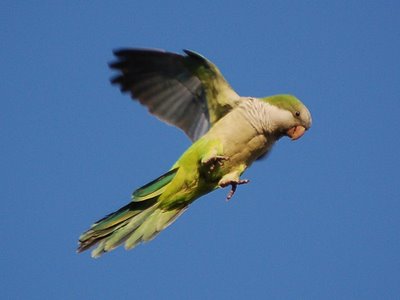
This wouldn’t have been noteworthy except for one small detail – the bird’s color. Instead of camouflaging its feathers to blend with a earth toned environment, the bird was bright green, like a crayon or piece of construction paper. Crossing the street, its wings flashed neon in a cardboard world.

Of course, I hold no prejudice against green birds. I believe all of God’s creatures should be proud of their heritage and display their colors without fear of drawing undue attention to themselves. It’s just that in most neighborhoods outside the Amazon, birds tend to be less flashy. Less exotic. Less green.

In Nashville, where I was running, we had many lovely blue birds, brown birds, red birds, and gray birds. We even enjoyed a few spectacular yellow finches. The only place in the Music City where you might find green birds, however, was at the zoo and on the Discovery Channel.

That’s why it was surprising, as I ran up a hill and into what I feared might be the beginning of cardiac arrest, when a wad of emerald feathers flashed across the sidewalk and into the great suburban wild of Nashville. I was certain the bird – a small fist-sized parrot – must have been an illusion, a figment of my sweating imagination. Had I suddenly tasted pennies or felt a tingling sensation in my left arm, the hallucination would have made much more sense and I might have expected to turn the corner and find myself running into a warm, white light.

But instead of a glowing end to my suffering, all I saw on the street was a rust red pick-up truck approaching on my right.

When you’re running and a truck passes going the opposite direction, you don’t have long to look through the windshield. Dolly Parton could drive past and you probably wouldn’t notice. But because the rust red truck was moving slower than it should have been, I had a few extra seconds to see the driver. Sitting behind the wheel was a sixty year old man, rough and unshaven, with gray hair, a red shirt, and a large green parrot perched on his right shoulder – the second parrot I had seen in the past two minutes.

With the exception of Jimmy Buffet – who lived in Nashville before he moved to Margaritaville – men in the Music City don’t generally wear parrots to work. In fact, the average Nashvillian knows as much about parrots as he does about recording contracts. Both are rumored to be real, but few have seen either in person.

After ten feet of careful consideration, I decided that the pirate trucker must have been driving through my neighborhood not because he wanted to spoil and plunder, but because he had a pet problem. It’s only a hunch based on unbelievable coincidence, but I think the pirate was the proud owner of not one, but two parrots - one lost, the other riding shotgun on his shoulder.

The parrot in the truck wasn’t simply along for the ride, tagging along to tell stories when the eight-track went out. It was being used as a zoological GPS to find the lost bird that crossed my path only moments before. The pick up pirate must have hoped that if birds of a feather really do flock together, he might be able to use this instinct to his advantage.

(I think it’s worth questioning whether a grown man should really trust directions squawked by an animal that has a vocabulary of only eight words, three of which are “cracker” and “pretty bird.” Personally, I wouldn’t. Of course, I don’t usually talk to anything that doesn’t have two external ears.)

It will forever remain a mystery as to why the little green spark flew away from home. Maybe he was tired of being served corn-nuts and Budweiser for breakfast. And while I will probably never know if the pick-up pirate was ultimately successful in his quest for the lost bird, I continue to be impressed by his effort. Finding a lost pet is never easy. At least when rounding up a runaway dog or searching for a lost cat, your pet’s hiding places are limited geographically by things like fences and streats. And gravity.

But when tracking a runaway parrot, there’s a tremendous amount of up to consider. The bird might be enjoying a bath in your neighbor’s backyard, or he might be eating french-fries with the parking-lot pigeons at Sonic. Or, if it hasn’t been fond of your brand of crackers, your bird might be on his way back to South America to teach a flock of its Brazilian cousins how to read the sports page in English. The sky is literally the limit.

As I rounded the corner, I glanced back to see the pirate’s truck turn left into a neighborhood filled with towering oaks and bushy maples. The Captain and his parrot sailed into the suburban jungle and I never saw them again. But on sunny days when the sidewalk calls, I still lace up my shoes and run. And I still sometimes wonder if the little green bird ever found its way home.

**

As a child I went through a stage of wanting to keep a bird as a pet. I was told, however, that it is both inhumane and inconvenient to keep a bird in a cage. Birds are born to fly free and cages are meant for naughty children who disobey their parents. Plus, depending on your political bias and opinion of the popular media, newspapers are intended to be read, not pooped upon. That’s why, in the redneck south, birds aren’t pets. Birds are target practice. Or dinner. Or both.

In Asian cultures a proverb says love is like a bird in a cage. If you love something, you set it free. If it comes back to you, it is yours forever. If it doesn’t, it was never yours to begin with.

In the Christian tradition, the bird is replaced with a sheep. The sheep is free to wander off – which it does – and is lost in the wilderness. Fortunately, in the traditional story, the shepherd is smarter than Little Bo Peep who lost her sheep and didn’t know where to find them. The shepherd knows his sheep and is convinced they are worth more than grilled kabobs and warm winter sweaters . . . so he leaves his flock to rescue the one who is lost.

And when he finds it, he joyfully carries it home where his friends and neighbors rejoice because the lost sheep is found.

During this season of Lent, I celebrate the shepherd Jesus. I am thankful that he is wise enough to know that love isn’t like a bird in a cage. If something you love runs away, you go after it no matter the cost.

Saturday, March 14, 2009

One in the Hand

Some people approach the new year like they approach a swimming pool in the spring, before the sun has really had time to share himself with the water. They step up to January first cautiously, poke one toe into the wintry water, and then decide that the only way they’ll survive the shock of a New Year is to dive head first into the deep. And so they take a breath and plunge into the New Year by making resolutions to change. To lose 100 pounds. To pay off all the credit cards. To learn Portuguese and read A Tale of Two Cities.

But what is it about the midnight between this year and the next that makes people decide they should make life altering resolutions? Why must we celebrate a new calendar year by buying a membership to a gym we’ll never use or spending ten torturous days dropping a smoking habit that we’ll be forced to find again in February? Why do we start our year with a maddening sprint when the finish line is still a long 365 days away? It just doesn’t make sense.

That’s why, when the New Year says jump, I don’t ask how high. I ask for how long and set the bar accordingly low. If I’m really going to commit an entire year to doing something that’s so unpleasant it requires a resolution, I at least want to know that I’m capable of finishing what I start. I like to set my New Year up for success by making bite sized changes that are small and easy to swallow.

For example:

One year I resolved to make my bed every morning. After 365 days of straightening my sheets, I finally realized how much more inviting it is to sleep in a bed that looks like it got dressed-up for the evening than it is to crawl into one that seems to have just wrestled a small goat. I liked the change so much I’ve made my bed every day since. Success.

The next year I committed that I would always hang my keys on the hook next to the front door instead of keeping them between the couch cushions or under my bed. I find that I’m much more punctual now and tend to swear less in the mornings. Success.

One year I told myself that I’d floss regularly. For the first three weeks of January I ate an unusual amount of corn-on-the-cob just to start the habit. This strategy met with mixed results. Literally.

I enjoy my manageable resolutions so much that several years ago I challenged myself to train for a marathon.

Three days a week I stretched my legs and laced my shoes, preparing my body to run its way through dehydration and heart attack. As anyone who has followed in these footsteps knows, whenever you attempt to run any mile number greater than your shoe size, death always feels approximately one breath away.

Although running carries with it both positive and excruciating side effects, it really is a wonderful way to learn your neighborhood. When you run, not only do you burn calories and exercise your heart, but you also see a snapshot of the people who share your sidewalk and your mailman.

For example:

When I ran the ten mile loop around and through my Nashville neighborhood, I often passed a thirteen year-old boy at the corner of mile three. I saw him only on colder days, but I think the boy wore his hood pulled up more for attitude than for warmth. He never smiled, and I learned that I shouldn’t either. Instead, when we meet on the sidewalk, we frowned coolly at each other and raised our chins in a sort of cranial wave. I assumed this meant hello, but considering the neighborhood it might have also been the boy’s way of telling me his pockets were filled with smokeable plants that he was “holding for a friend.”

If the boy’s nod was some sort of subtle sales pitch, I hope he takes a marketing class when/if he gets to High School. The boy obviously has no idea of how to recognize his target consumer. Trying to sell weed to jogger is like trying to sell a bikini to a nun . . . in December.

I also occasionally saw a man I called “Cross Country.” When he ran, Cross Country looked as if he was concentrating, like his mind was thinking about things like form and balance and breathing, like his brain had to focus to control his body. Until I began training for the marathon, I had no idea running was so complicated. I thought it was simply an evolution of walking that we all learned when we were toddlers and our cholesterol had not yet awoken.

When he jogged past me, Cross Country never nodded to acknowledge that we were both sweating through the same sadistic ritual. He ran in his own world, and no one else was invited. Cross Country wore special shirts that were loose and synthetic and probably designed to recycle his sweat and prevent dehydration. Not me. I wore pre-stained shirts bought from the bargain bin at Goodwill. They were 100% cotton and advertised everything from credit cards to Christian camps. They also retained water like a pregnant woman.

Some people like to run with partners or groups so they can encourage each other along the way. But what is there to say while you’re running except “help,” “oh God,” and “glycerine”? When I run, I don’t want to be encouraged. I want to be alone. Sometimes I don’t even listen to music. Although I like the distraction of music, I get mad at the singers for breathing so easily.

Once, however, I was running up the hill that marked mile eight when I passed a fellow jogger who smiled and shouted “That’s right! Good job!” as he reached out his hand and gave me five. At the time I was so busy needing something actual like oxygen that I didn’t feel the need for something abstract like five. To my surprise, however, an encouraging slap from a stranger was exactly what I needed to finish the last two miles. When I collapsed exhausted in front of my house, I repeated his words “That’s Right” and “Good Job” just before I threw-up.

Then, one afternoon, just after I passed the hooded boy and shortly before my encounter with Cross Country, my heart and iPod were each thumping their own separate rhythms when a homeless man stepped into the sidewalk fifty feet in front of me. The man looked confused and unsteady, like someone who has just rolled out of bed and is still uncertain of how to start his day.

In my mind, I called him Oscar.

I gave the homeless man this name not because of his unusual aroma or wild, discolored hair. I didn’t call him Oscar because he was green or because I had ever seen him associate with a Cookie Monster, Big Bird, or Mr. Snuffleupagus. In fact, I don’t think there was a Sesame Street anywhere near my house. I called the man Oscar because of his unpleasant personality and half-empty attitude.

Oscar was a grouch.

After climbing over the curb and into my path, Oscar stood in the sidewalk silently watching the cars pass. He looked left. He looked right. And when Oscar finally turned toward me, made eye contact, and raised his right hand, I smiled, preparing to wave and say hello as we passed, pleased that I was making a new friend.

It soon became clear, however, that Oscar wasn’t interested in becoming friends. If he had been, his raised hand would have been opened in a gesture of welcome and brotherhood. But it wasn’t. His hand was almost entirely closed. Except for one lone finger.

Fortunately, since the middle finger is the tallest of all the fingers, it can be most easily seen from the farthest away. Even at fifty feet I knew exactly what Oscar was trying to say, and it wasn’t hello.

(As a child, I often played checkers with my grandfather. We called him Granddaddy Jack, but I’m not sure why. His first name was Harvey and his second name was Lee. We called him Jack because that’s how he was known to everyone in the small town of Trenton, Tennessee where he lived - but I don’t think anyone in Trenton knew why he was called Jack either.

I liked to play checkers with my Granddaddy Jack because he had style. When we sat down to play, Grandaddy Jack didn’t move the checker with his pointer finger like I did. Instead, he always used his long middle finger . . . his “bad finger” . . . the finger tough kids on the playground used when they were angry . . . the finger that got you sent to your room without any dinner if you used it while you were shouting at your sister. Granddaddy Jack was a deacon in his church and a man of great integrity. He never got in trouble on the playground and probably had no idea why I giggled every time he moved his checker.)


Oscar began his unfriendly gesture when we were still a staggering fifty feet apart. As I ran toward him, the grouch and I stared at each other for every bit as long as it has taken you to read this story. I’m not a very fast runner. And for each of those seventy-five awkward steps, Oscar’s finger stood in its lonely salute as a testimony to his feelings for me. He and his finger hated me for fifty feet. It was like watching a Peter Jackson movie or reading Tolstoy or listing to Queen’s almost six minute Bohemian Rhapsody. Oscar’s grouchy middle finger took a simple message and turned it into an epic statement.

I would like to think that Oscar was like my Granddaddy Jack and was simply using his middle finger for some innocent and utilitarian purpose. Maybe he was checking the wind or letting his nail polish dry. But I don’t think so. Oscar didn’t seem like the nail polish type.

But because I try to see the best in other people, I choose to believe that when Oscar raised his finger that day, he had the best of intentions. He probably meant to give me five and simply forgot the other four. I understand. I’m not very good at math either.

That’s why, when we passed, I decided that Oscar didn’t need something actual like income. He needed something abstract like encouragement. And so, instead of ignoring him or saying something unkind and trotting by in a sweaty blur, I acknowledged Oscar’s finger with a smile, gave him five, and cheerfully said “That’s Right! Good Job!”

And then I finished my last mile, happy to be a bright spot in someone’s day.

Thursday, March 5, 2009

Slippery Squirrels


I'm not sure why my mom hates squirrels, but I think it started with popcorn.

In an age before coaxial cable wired HBO and Showtime directly into televisions across the United Sates, the first VCRs found their way into suburban living rooms when I was in elementary school. Prior to the VCR, if you wanted to watch a movie you were forced to either see it in the theater or wait ten years until a highly edited version was shown on one of the three network channels your family’s television was able to tune-in. The houses of my childhood looked like giant bricked insects with aluminum antenna mounted on their backs. TV Guide was much thinner.

The idea of preserving video on cassette tape revolutionized the free time of an already television addicted generation. The new VCR recorded our favorite shows and gave children the freedom to go to the bathroom sometime other than during commercial breaks. It allowed us to pause, rewind, and skip the boring parts of programs we taped while we watched the Cosbys settle this week’s crisis or the Miami Vice keep Florida crime free. The VCR helped us memorize favorite jokes and imitate the characters who were live on Saturday night. It let us watch any movie any time we wanted to. It did for cinema what reruns had already done for television. It gave us a second chance.

I’m convinced that both the newly invented VCR and its accomplice, the video rental store, were also ultimately responsible for the great squirrel invasion of 1986.

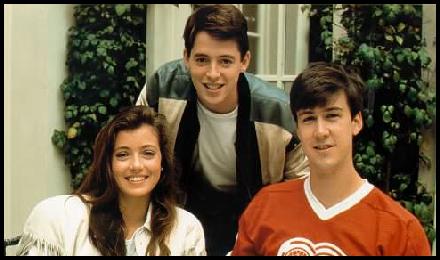
One particularly warm summer night my parents piled my sister and I into the family station wagon and drove us to the new local video store to see what blockbusters it might offer as entertainment for the evening. As always, the choices were so overwhelming that Kathy and I argued over what we would watch. I wanted to rent an action move. She wanted a drama. I wanted to laugh. She wanted to cry. It wasn’t until we remembered that a boy named Ferris Bueller had recently narrated an entire movie about how to take the perfect day off that we reached a compromise: I would rent the movie about the kid who knew karate, my sister would watch Molly Ringwald blow out her sixteen candles, and we would both enjoy learning from Ferris, Cameron, and Sloane the fine art of skipping school.

After a night of watching movies and popping popcorn, Kathy and I were cleaning the living room when my mom noticed a few handfuls of popcorn left in the bottom of the bowl. Before we could put the uneaten corn in the trash she said, “instead of throwing that popcorn out, you guys should toss it in the backyard for the birds to eat. Wouldn’t that be fun?”

At the time, the idea of throwing leftover food in the backyard for birds to eat seemed both indecent and exotic. My family usually put its leftovers either in Tupperware or in the trash. We never threw them in the yard. But since Jesus didn’t seem to get too upset when his five thousand friends left a bit of stale bread littering a rural hillside, we decided that tossing a few kernels of popcorn in the backyard might not be such a bad idea after all.

Feeding the birds with our table scraps quickly became a game for my sister and I. For several weeks after the first popcorn feeding, when my mom baked biscuits or made cornbread for dinner, Kathy and I fought for who would win the right to crumble and scatter the uneaten bread across the yard. Although the project was really less about feeding hungry animals than it was about making our backyard look cheerful and charitable, the birds loved our homemade treats, and we were convinced they loved us for providing them. Our backyard soon became a bird buffet with loyal customers ranging from blue jays and cardinals to robins and redbirds.

We eventually graduated from feeding the birds discarded popcorn and biscuits to using an actual birdfeeder. Our first one looked like a little pine house on a pole. Its clear plexiglass sides let potential diners see what kind of seed we were serving for dinner, and we soon found the birds were just as happy with convenience food as they had been with home cooking.

The cardinals enjoyed a diet rich in sunflower seeds while the doves and finches ate lots of wheat. Thistle seed was a favorite of the goldfinches. The mockingbirds, blue birds, robins, and woodpeckers enjoyed dried fruit in the feeder. For the sparrows, we bought lots of millet. When you consider their diet, it’s really not surprising that birds have become infamous for giving a sh** where others dare not.

Although our intent had always been to feed the birds, squirrels apparently enjoy bird seed as much as birds do. And since birds tend to be fairly messy eaters, they usually supplied the squirrels in our yard with a fairly constant rain of castoff sunflower seeds and millet to supplement the thousands of acorns already littering our yard.

I would like to think that that most creatures who can’t enjoy the luxury of large franchised supermarkets would be content with free food raining from the sky. Our squirrels, however, were smart enough to understand that the shower of seed raining from above was coming from somewhere other than heaven, and they wanted to know where that somewhere was. When the first squirrel championed an expedition up the birdfeeder pole and found a small wooden house full of food at its summit, he knew his days of foraging and hoarding were over.

In the frenzied seconds that followed, the air in our backyard grew thick with fur and flying seed. Until I witnessed the squirrel’s appalling table manners, I never imagined that animals could binge eat. It was a Jenny Craig nightmare. In less than a minute, a single squirrel emptied our entire birdfeeder of its contents. While some of the seed must have found its way into the squirrel’s small mouth, most of it flew like Cookie Monster crumbs across the yard and was quickly collected by the squirrel’s waiting (and grateful) friends.

My mother was mortified. After months of enabling the birds with a steady diet of ever-available seed, she was convinced they would no longer be able to survive in the worm-eating world. Thanks to the selfish squirrels, she said, our backyard birds were going to bed hungry.

And so began our quest to protect the birds and keep the squirrels out of our birdfeeder.

Plan A:

Our first anti-squirrel experiment involved a cone that was attached midway up the birdfeeder pole with its open side down. The cone made our birdfeeder look like a skinny one-legged girl wearing an aluminum dress. In theory, the hungry squirrels would climb half-way up the pole, reach a dead end, turn around, and give up. Unfortunately, our squirrels either didn’t think the birdfeeder’s new outfit made it look like an underfed supermodel, or they were terribly immodest. Not only did the squirrels continue to climb up the birdfeeder’s one long leg, but they also found a way past her shiny aluminum skirt and into her feed box, where they eagerly scattered their seed.

Who could blame us for our outrage?

Plan B:

Because, as natural climbers, the squirrels would always find a way up the birdfeeder pole, the next logical solution was to eliminate the pole altogether. If the birdfeeder could somehow be suspended in midair, the squirrels would be forced to wait for evolution to grant them the gift of flight before they could steal our seed. And since evolution is notoriously slow, hanging the birdfeeder above the ground seemed like a marvelous idea.

After three trips up a stepladder, a tightrope of clothesline cord was strung between two trees with the birdfeeder dangling from its middle. Unwilling to wait for wings, however, the squirrels decided to attack from the trees. Two hours after we hung the birdfeeder, a squadron of squirrels dove from the branches, landing on the birdfeeder’s roof and swinging it until every seed had been thrown from its hold. The troops waiting below devoured the seed in moments, eating it off the ground and picking crumbs from each other’s fur.

Until that spring, I never considered that birdseed is actual seed, but it is. And like all seed, it grows. April showers usually bring May flowers, but by June our yard grew more than daisies and tulips. Thanks to the squirrels and their seed scattering, the spring rain of 1986 transformed our backyard into a half acre of suburban farmland.

While our neighbors’ yards grew dandelions, ours sprouted sunflowers. While other neighborhood dads tried to keep their crab grass under control, mine fought a backyard full of summer wheat. And as the squirrels continued to sow their seed, I became increasingly aware that I had somehow transitioned from mowing the yard every Saturday to harvesting it.

Plan C:

My Uncle Frankie, the Peter Pan of our clan, devised a plan to eliminate our squirrel problem that involved a five gallon tub of Crisco and a pair of latex gloves.

Although we should have known better than to play along with whatever Neverland game my uncle’s imagination had invented, we didn’t. Instead, we followed Uncle Frankie’s advice and smeared handfuls of shortening along the length of our birdfeeder pole.

Uncle Frankie claimed that this homemade slippery pole would make it impossible for squirrels to climb all the way to the birdfeeder above. They might make it half-way, but the combined forces of gravity and whipped vegetable fat would ensure the birdseed’s safety. He personally guaranteed that the Crisco pole could be conquered by not even the most persistent squirrel. Climbing it would be impossible, like climbing a stick of butter.

Uncle Frankie was right. The Crisco pole was an unparalleled success and as entertaining as it was effective. A few ambitious squirrels made impressive attempts at climbing the greased pole, but after four lubricated feet their exhausted arms lost their grip and they inevitably slid slowly back down like small, greasy firemen.

(The whole scene was reminiscent of that torturous day in jr. high gym class when the girls were moved to one end of the gym to play kick-ball while the guys were herded to the opposite corner and told to climb a giant rope hanging from the rafters. For some unknown reason, gym teachers always wanted us to climb the rope, as if this was a life-skill that boys were required to master before adulthood. Didn’t our gym teachers understand that most modern buildings are equipped with both stairs and elevators? Unless your career goals include becoming a pirate, I could never think of a single job that would require a grown man to climb a rope on his way to the office. And yet, they still made us climb.)

After several unsuccessful hours trying to pillage the birdfeeder, the poor squirrels sat at the bottom of the pole, spent and frustrated, licking the Crisco off their paws. Since squirrels generally survive on nuts, berries and the occasional high fiber-bug, their small bodies aren’t accustomed to an un-cut Crisco diet. And so, thanks to both my Uncle Frankie’s brilliant plan and my family’s blind obedience, our yard was quickly filled with the fattest squirrels ever seen in the wild.

At the end of a long day of pole climbing, when the greasy squirrels finally summoned enough energy to drag themselves back home, tree branches creaked and groaned under their pot-bellied weight. The summer was particularly harsh as several of the cat-sized squirrels baked to a golden greasy brown in the hot August sun.

**

More than two decades have passed since the great squirrel invasion of 1986, and its final moments have been lost to memory. All we know for sure is that what began with the Hansel-and-Gretel-like innocence of children dropping crumbs in their backyard quickly degenerated into a Crisco-covered mess.

Family lore doesn’t record who finally won the battle or how. But as we laugh over the story during countless Thanksgiving dinners, my mother continues to defend her actions. She says she simply hoped that if we put the food just out of the squirrels’ reach for long enough, maybe they’d get frustrated – maybe they’d give up and go away.

Not long after our backyard conflict was resolved, a more significant family battle began that eventually caused my parents to divorce each other and re-marry other people. When I was a senior in high-school my mom met and married a wonderful man named Bob and together they moved into a home that wasn’t haunted with memories of slippery squirrels and starving birds. The hummingbird feeders that now hang in their kitchen window are filled with sugar water. While these feeders attract the occasional winged insect, they are never fought over by anything larger than a bumble-bee.

Unfortunately, at her new house my mom is now doing battle with another rodent foe. A family of chipmunks has invaded the yard and is threatening my mother’s sanity. She and Bob have approached this new challenge with very different strategies. Bob is a kind and gentle man who has attempted to re-habilitate the chipmunks in an unsuccessful catch-and-release program. My mother prefers a more aggressive approach. She wants to adopt a hungry cat.

My Uncle Frankie has a brilliant solution to the chipmunk problem that involves steel wool and peanut butter, but we don’t listen to him much anymore.

Saturday, February 21, 2009

Zoo Cow

Once there was a Cow who lived in a zoo. He lived next door to the Panda and across the path from a Zebra, but they didn’t talk much. The Zebra was always busy and the Panda never had much to say.

Plus, they were fancy and the Cow was plain.

The Panda was wonderfully white with black spots and the Zebra was beautifully black with white stripes. But the Cow wasn’t extraordinary at all. He was just regular white except for a big black patch on his back.

Black and white.
White and black.
All three of them looked like I Love Lucy reruns standing in a field.

The children loved to watch the Panda and wished they could pet the Zebra. But when they stopped in front of the Cow’s fence, it was usually just because they needed to tie their shoes or because they found a stray nickel. Most children had seen a cow before.

One child had seen a cow on a milk carton.

Another had seen one holding a sign in a fast-food chicken restaurant.

The little boy with a balloon had even been brave and touched one once when he drove from the city and visited his Grandfather’s farm.

The Zebra loved it when the children took pictures of his beautiful stripes and watched him run across his field. Their shouts and flashes made him feel special. He sometimes wondered, however, what would happen when the children realized that he was really just a horse with stripes who was afraid of lions. They would probably think he was ordinary and boring and never come back to visit.

The Panda adored the bronze plaque that told everyone she was born in a far away place called China. It reminded her that she was rare and wonderful. She spent all day pointing at it so the people would notice, but she was secretly afraid that the children would love the monkeys better than her because they whooped and hooted and threw their poop at grown-ups.

The Cow stood in his field wishing the sticky faced children would think he was something other than ordinary. He often heard their parents call him Grade A and Prime, but somehow their comments never sounded complimentary.

One day a group of children came to the zoo in a big yellow bus. They stopped to look at the Cow, but only because their teacher told them to.

“The Cow looks lonely.”
“The Cow smells funny.”
“Why does the Cow have flies on its butt?”
“Are cows stupid?”

The children were loud and asked lots of questions.

One little girl said, “Mrs. Jenkins, is that the kind of cow that makes milk like I put on my cereal?”

“No,” Mrs. Jenkins said. “That’s the kind of cow that makes hamburgers like we’re eating for lunch.”

The little girl rolled her eyes. She was a vegetarian. Her mommy said that hamburgers would give her cholesterol. The little girl didn’t know what “cholesterol” meant, but since she already had cooties, she wanted to be extra careful.

The Cow felt trapped in the zoo. Lonely. Of course, most animals feel trapped in a zoo. That’s why it’s called a zoo and not a forest or a farm.

The Cow, however, didn’t feel trapped because of the gate. He wasn’t lonely because he didn’t get to visit faraway farms and factories like the country cows did.

The Cow felt trapped because the children and their questions reminded him that he would always be a cow - different from the other animals around him. No matter how hard he tried, he would never be as cool as the Panda or as interesting as the Zebra. He would never climb a tree or race like the wind. He didn’t like bamboo, and whenever he wore stripes, they only accentuated his already round belly. The most the Cow could hope for in life was a fresh bail of hay, a vague fantasy about a stampede, and a bell around his neck ringing to remind everyone that he was a big fat cow.

And so the Cow spent every day eating his grass – ignored and out of place – feeling like a cow in a zoo.

One day a Chinese woman came to the zoo and stopped to look in the Panda’s cage. She yawned when all the Panda did was pose and point and eat bamboo. The Chinese woman wondered if the zookeeper might have any ideas for keeping pandas out of her backyard. It made her angry every time she saw one of the black-and-white beasts snacking on her serenity garden.

The same day, an African man seemed mildly impressed with the Zebra, but in a hungry way that made the Zebra nervous.

Later that day a little boy came to the zoo wearing blue jeans held up by a belt with an impressive silver buckle. The boy walked past the Panda and didn’t care much for the Zebra. But at the Cow’s pasture he stopped and watched for the longest time.

The boy stood next to the Chinese woman as she tried to offer the Cow a piece of her hot-dog. She seemed disappointed when he refused.  An African man behind the boy whistled so the Cow would run and play, but the Cow didn’t want to run and play. Especially not when someone whistled at him.

But when the boy saw the Cow he didn’t take pictures or point. He didn’t poke his hand through the fence or make loud noises. Instead, he watched. He watched until long after the Chinese woman and the African man left.

The boy wasn’t afraid of the cow, but he wasn't impressed by it, either. He knew that cows are nothing to be scared of. He also knew that it’s better to understand something than to be impressed by it. And he already understood the Cow. Little boys wearing belts with big silver buckles usually do.

The Cow ate his grass and watched the little boy watching him. It was good to feel ordinary and unimpressive. After a long while he finally realized what the Panda and Zebra never would.

When someone really understands you, your cage doesn’t seem so small.

Wednesday, February 11, 2009

Christmas in Five Acts

I realize that Christmas 2008 was thrown out with the wrapping paper almost two months ago. But as many of you know, the last year has been . . . well, transitional. Chaotic. Hopefully you’ll forgive me for posting an out-of-season story that I’ve only just finished. If you do, I’ll forgive you for wearing white after Labor Day. -b

Act 1. The Problem:
Even though the last days of December are already hectic for both Santa and Jesus, I thought it was appropriate to tell history's two most popular people what happened. Since neither seems overly concerned with justice, I feel it's necessary for someone to help them update their naughty lists during the busy season.

Of course, I don't fault them with what happened. I understand that neither Jesus nor his party planner spend much time watching locker rooms at the YMCA - especially at Christmas. To do so would almost certainly be a violation of the omniscience that has made them each famous.

But that doesn't excuse the fact that I was robbed.

Act 2. The Setting:
My sister’s Christmas tree was spectacular, planted in a mulch of ribbons and wrapping paper, blooming with a hundred colored bulbs. Angels and snowmen nested in branches drooping with a harvest of fragile glass balls. The poor thing should have been the happiest tree on earth.

Kathy is a good mother. She waters her children regularly. They're so hydrated they sometimes leak at night. She even gives Santa, who only stops by for a few minutes each year, a glass of warm milk and cookies. The Christmas tree, however, endured its three week stay in my sister's house without her offering it the smallest sip of water.

For all its decoration, the tree might as well have been a princess parading through a dessert - dressed for a banquet, but dying of thirst. Parched, it probably spent the entire Christmas season wondering how an eight foot evergreen transplanted to a suburban living room and covered with flashing lights could possibly be forgotten by a family of four.

Sadly, it happens – especially at Christmas.

Act 3. The Situation:
Children’s minds get cluttered at Christmas. At least twice during the holidays they need to have their brains washed to clear the visions of sugarplums out of their heads. Bloody slasher movies do the trick, but most parents prefer things like playgrounds, trampolines, bike rides, and basketball.

Four days before Christmas, Kathy told her kids that they were going to the swimming pool and Uncle Bryan was coming too. The Children cheered and changed their clothes. The Christmas tree sighed.

“Mammals,” it thought, “have all the fun.”

It was right. Four days before Christmas, we went swimming.

Act 4. The Stupidity
Does Santa lock his sleigh so kids out after curfew don’t swipe his pack of smokes off the passenger seat?

Did Mary lock the manger door to keep loitering shepherds from stealing her family’s new stash of gold, frankincense, and myrrh?

Do the elves lock their toys in a trunk every time the Tooth Fairy comes for a visit?

No. Of course not.

In a similar spirit of blissful trust and unintentional generosity, when we went to the pool I didn’t lock my locker.

Act 5. The Scandal:
The kids who stole my cash didn't care if Santa watched when they were sleeping. According to a Christmas carol loophole, by day he only knew they were awake.

If the details of their waking lives, and therefore their hopes for a coal-free Christmas morning, were protected by this technicality – why shouldn't they help themselves to the contents of a stranger's wallet?

Answer: Even if he wasn't watching when they opened my locker door, Santa will see the aspiring young convicts at the mall next year. When he does, he'll wonder where they got the money to buy those new shoes he wasn't asked to make and he'll know why they no longer need his services.

So don’t forget, little thieves, your name never gets crossed off his list. It only gets moved to a different column. This is where the two Christmas patriarchs part company. Santa holds a grudge.

Tuesday, February 3, 2009

Close Enough

Everybody has an airport story – that excruciating tale of waiting on the runway for four hours that's unique to everyone we know.

They’re among our favorite stories to tell because we’ve rehearsed them so often, perfected their timing and developed their characters. We can perfectly describe both the woman who filled two seats in row three and the man who somehow lost his barf bag. During each of our repeat performances, we remain confident that nobody can compare turbulence to a roller coaster quite like we can. Our accounts typically begin with subtle and understated openings like, “Not long ago I had to fly to . . .” and end with the self-conscious clincher, “well, it was just terrible.”

We usually tell these stories at parties, not because they’re particularly interesting or original, but because someone else opens the door with their own travel nightmare. And even though everyone in the kitchen is bored with the subject as soon as they’ve told their own tale, we’re convinced they’re still listening on the edge of their seats, sitting in an upright and locked position while we finish a monologue about our luggage being lost.

“Well,” we say, “it was just terrible.”

And by the time we’ve finished talking, everyone agrees. That really was just terrible.

**

After a recent trip to visit my family in Nashville, I was scheduled to land at New York’s LaGuardia airport. Half-way through the flight, 40,000 feet over impending doom, the pilot made the following announcement:

“Excuse me ladies and gentlemen. Please pardon the interruption, but we’re experiencing a few technical difficulties we’d like to make you aware of. Don’t worry, there’s nothing wrong with the plane. But our brakes don’t seem to be working . . . “

Being a man of words, I quickly applied an editorial ear to this announcement and gleaned the following key phrases. One of them feels a bit conspicuous, like it doesn’t belong with the others. You have to bend its corners to make it fit. Can you guess which one?

1. We’re experiencing technical difficulties
2. There’s nothing wrong with the plane
3. Our brakes don’t seem to be working

If we’re (1) experiencing technical difficulties and our (3) brakes don’t seem to be working, then it logically follows that there is something wrong with the plane. Feeding a metal tube full of passengers that small spoonful of sugar does not help the medicine go down.

I wonder if the captain of the Titanic, the pilot of the Hindenburg, or any of the Space Shuttle Challenger crew ever started a speech with “there’s nothing wrong with our ship, but...”

Consider a mother panda telling her tear stained daughter, “sweetheart, there’s no need to worry. We’re not going extinct... but there’s a reason you don’t have any friends.”

Or Santa mentioning during a staff meeting, “you all know that global warming is a complete ho-ho-hoax... but I was thinking that maybe we should make our uniforms with shorter sleeves next year.”

Or a Native American man saying to his son, “the nice white people said they don’t want our land... but if you were going to pack your four favorite things into a box, which four things would you choose?”

The “but” serves the same purpose in these speeches as it does on the human body. It’s just fleshy nonsense that does nothing but cushion an impending blow to your backside.

After the announcement, a wave of quiet panic swept through the cabin. The woman filling two seats in aisle three tightened her already strained seatbelt. A man holding a curious smelling sack excused himself from row twelve. While most of the passengers wondered why oxygen masks hadn’t already fallen from the ceiling, the passenger sitting in my seat wondered how the pilot discovered our brakes weren’t working.

Did he tap the left pedal and notice a sluggish response? Considering that objects in motion tend to stay in motion, would that really be cause for alarm? I suspect that driving a 400 ton passenger jet is not unlike managing a nuclear conflict – once it’s started, it’s probably difficult to stop – and for good reason. Principals like inertia, momentum, and gravity dictate that stopping suddenly at several thousand feet is an exceptionally bad idea. To be no longer moving forward is to be quickly moving downward. Stories of airplanes stopping suddenly usually end with words like “crash” and “tragedy.”

The pilot, however, wanted us to stop not immediately, but sometime shortly after reaching the airport. Unfortunately, the airport was as much of a problem as our broken airplane. The runways at New York’s LaGuardia Airport are apparently too short for a 400 ton jet hitting the ground at 160 mph to stop using only its emergency brakes. Errant planes at LaGuardia coast off the end of the pavement and drop into the East River, never to be seen again.

In an effort to save 200 passengers the trouble of using their seat cushions as flotation devices, our pilot radioed the tower and requested that our flight be re-routed to New York’s JFK airport, where the runways are longer and don’t force emergency brakes to work under such impossible deadlines.

Geographically, the change wasn’t significant. It wasn’t as if LaGuardia closed unexpectedly and forced planes to land in Los Angeles, 3000 miles away. Our flight was simply re-routed from one side of the city to the other. Only twelve miles apart, LaGuardia and JFK are as close to each other as a person’s elbows are to his knees. The same taxis, trains and shuttles connect them both to New York’s mid-section, home to the city’s Empire State Belly Button – one of the largest outies in the world.

Despite our broken brakes, several passengers seemed concerned not that we might experience a rough landing, but that the inflatable slide might dump us out at the wrong airport.

A college student pressed her call button and asked the already frazzled stewardess, “But what about our luggage? I mean, how are we supposed to get our bags?”

The stewardess paused and inhaled deeply through her nose. “The pilot thought it would be best if we all arrived together,” she said, “so he had your luggage re-routed to JFK as well.”

“Oh,” the girl said. “good.”

**

When our plane finally bumped onto the runway, several people jerked awake from long in-flight naps. They wondered why their fellow passengers applauded and cheered when the plane finally pulled to a stop. Were the lights and sirens escorting us down the runway celebrating ours as the one-millionth landing? Would there be prizes? Would we each be awarded a free membership in the mile-high club?

As old men stretched and young women collected their belongings, the pilot made his second big announcement of the evening. First he confirmed that we had just landed safely at JFK, stopping well before the end of the runway. He then announced that the airline had arranged for a shuttle to take us to LaGuardia.

A few tourists smiled, obviously believing this was good news.

The rest of us wondered, why would we ride a crowded bus to LaGuardia when for $2 the subway will take us from here to anywhere we want to go?

“Must we take the shuttle,” a passenger asked. “Will it be possible to retrieve our luggage and leave from here?”

“No,” came the reply. “According to FAA regulations, all luggage must be loaded onto the new airplane that will fly us to LaGuardia.”

Airplane? Fly? Had the airline that charged $25 for each of our bags and would soon deny us a small cup of free soda really arranged for an airplane to fly us the final 12 miles to LaGuardia?

According to the pilot whom we applauded only moments before, the answer was yes. He assured us, however, that this would be a relatively simple process:

As soon as our replacement plane landed (45 minutes) and it’s passengers unloaded (20 minutes), the cabin would be cleaned (15 minutes) and our luggage would be transferred while we re-boarded the new plane (30 minutes). We would then wait for clearance to take off (25 minutes) before we flew the final 12 miles to LaGuardia.

In other words, it would take the new airplane over two hours to shuttle us 12 miles.

A handicapped toddler could carry our luggage to LaGuardia faster than that.

This news raised the terror alert on our flight from an ever-present orange to a more realistic red. Even the love-starved co-ed with a boyfriend waiting at the wrong airport threatened to join our mutiny against the shuttle. In our solidarity, we would not allow the airline to hold our luggage hostage. We would not fall victim to their ill-conceived customer service. We would not add two needless hours to this already nightmarish trip.

Like Moses and Martin Luther King, Jr., we fought for our freedom.

“We have a right to ride the subway,” we cried.
“You can’t force us to the back of a bus!”
“Let our luggage go!”

When a stewardess started to cry, however, everything settled down quite a bit.

In reality, the angry passengers who complained did it mostly to each other. Their shouts were little more than the mumblings of tired and passive-aggressive passengers. A man in first class might have threatened to sharpen his seat-belt buckle into a shiv, but to my knowledge he never followed through with his plan.

Eventually, the jetway extended. Overhead compartments emptied as passengers shuffled to the front of the plane. A gate agent met us in the terminal. “Your luggage will be delivered to carousel three,” he said. “You win. You’re all free to go home.”

“But why,” he asked. “Why all the commotion? LaGuardia’s not that far away.”

An exhausted mother turned and smiled, wearily. “Sometimes,” she said, “when you don’t land where you thought you would – close is close enough.”

**

Once upon a time I would have called this attitude “under achieving.” I would have argued that as people built with divine purpose, we weren’t meant to smile wearily when life stops 12 miles short of where we think it should.

But that was back when things like potential and possibility seemed more definite than they really are – when the future was clear because it was still far away.

Now that the future is right in front of me, it’s terribly hazy.

Now I find myself asking my God and my resume’ to shuttle me safely to where I think I belong – to a patch of greener grass that I always assumed was mine. But maybe it isn’t mine. Maybe it never was. Maybe this patch of greener grass was grown for me.

Sometimes, when you don’t land where you thought you would, close is close enough.

Thursday, October 2, 2008

Five. a fiction

For most people, birthdays are a Christmas you aren’t forced to share with anyone. On your birthday, you are celebrated for your own nativity – rewarded for a day you don’t remember. Friends carol you over cake as wise men and grandparents bring presents from afar. “Blow out the candles!” party guests yell, celebrating your good fortune, knowing the cake won’t be cut until you make a wish.

Gracie looked especially forward to the day that marked the end of her fourth year and the beginning of her fifth. Honestly, though, it wasn’t the new age that thrilled her most. It wasn’t the upcoming presents, the candles or the cake that kept her awake at night. She looked forward to the day of frenzied children running through her house, but that wasn’t what inspired her countdown. Gracie was excited because she had already done the birthday math and added all the elements into one very special event.

Her party.

Gracie invited everyone to her birthday party, including (but not limited to) the boys and girls in her class at school, the lady who cut Mommy’s hair, the children she played with at church, two people at the grocery store, the postman, and a confused cashier at McDonalds.

Her Mommy and Daddy would be there, of course. They even promised to let her help hang balloons before everyone arrived. Her brother would spend the day entertaining guests with magic tricks. Her cousin would cry. Mimi would take pictures and BobBob would play his guitar while her friends sang “Happy birthday to you – happy birthday to you – happy birthday dear Gracie . . .”

Everyone would be there – except Uncle Bryan.

Nobody loved Gracie like Uncle Bryan did. He told her so every time they played together. Uncle Bryan read stories to her and played dolls with her and pushed swings for her and caught her when she jumped into the swimming pool like a big girl.

Gracie knew that Uncle Bryan wasn’t coming to her party. She remembered the goodbye sleepover at his house. She remembered drawing pictures on the boxes so Uncle Bryan would remember her when he got to his new city. Gracie knew that Uncle Bryan moved to New York. What Gracie didn’t understand was that New York was more than a birthday party away.

And so, when her mommy interrupted the party to say that someone on the phone wanted to talk to her, Gracie squealed with delight.

“Uncle Bryan!” she screamed across the country, “When are you coming to my party?”

Before he could answer Uncle Bryan heard his sister intervene.

“Sweetheart, Uncle Bryan called to tell you happy birthday because he can’t come to your party.”

“But he promised!” Gracie protested, excited differently than before.

Of course, Uncle Bryan was smart enough not to make promises to little girls that he couldn’t keep. “Gracie,” her mommy said, “Uncle Bryan promised he would come home for Christmas, not your birthday.”

Unfortunately, Gracie had already wrapped her birthday with paper, piled it with presents and filled it with pictures and playing.

“It’s the same thing!” she demanded.

Before the adults could correct her, Gracie turned away, pressing the phone tight against her face. Uncle Bryan was asking her if she could keep a secret, even though he knew she couldn’t. The whispered conversation filled Gracie with more excitement than she could hold. Forgetting a promise made to her uncle only seconds before, Gracie ran through the house shouting the news:

“Uncle Bryan said he’s coming to my party!”

Some secrets are simply too big to fit inside a little girl at a birthday party.

Mommy tilted her head and smiled. Gracie noticed that it was the same smile Mommy used every time her brother said he was going to be a magician when he grew up. The mommy knew, of course, that little girls who play with dolls are sometimes prone to invent conversations. The voices in their heads, while entertaining, are seldom accurate.

Fuzzy Bear asked for sugar in his tea.
Puppy said he isn’t feeling well.
Mr. Whiskers told me he likes it when I cut his hair.
Uncle Bryan said he’s coming to my party.


While all such sentences may sound equally unlikely, parents who hang stockings over fireplaces, fill baskets with chocolate and eggs, and encourage their children to hide discarded teeth under their pillows should be careful when debunking the fantasies of small children.

Mommy reached down to take the phone from Gracie, but Gracie had already folded it in half, ending the call.

“Gracie, sweetheart,” Mommy said, “you must have misunderstood.”

Gracie, however, wasn’t listening to her. She was busy inspecting the cake and asking Mimi to cut her another piece.

“Gracie, did your mother say you could have another piece of cake?”

“No. It’s for Uncle Bryan,” Gracie said. “We need to save him some.”

Mommy and Mimi exchanged a look that wasn’t quite as far over Gracie’s head as they must have thought.

“Gracie,” Mimi said, “I know you miss Uncle Bryan.”

She paused, the short silence undermining her confidence. She missed Uncle Bryan, too. When it was manageable, Mimi continued, “but do you remember what Mommy told you this morning? Uncle Bryan lives too far away to come to your party.”

“But he said to save him a piece of cake!”

Despite her best efforts to include them in her joy, the grown-ups continued trying to keep Gracie’s hopes from getting too high. Didn’t they understand that hopes are supposed to be high at a birthday party? They even tried to distract Gracie with presents, a tactic proven successful by generations of parents, but Gracie said she would wait to open them until Uncle Bryan arrived.

“Honey, this one’s from me and your mother,” her father said. “Don’t you want to open it?”

“No! Uncle Bryan is coming to my party!”

Gracie almost never got to say “I told you so.” Little girls seldom do. It’s not that they’re always wrong, as some girls grow to believe.  But when you’re five years old it’s seldom that you are ever more right than anyone else – a fact that everyone else seems acutely aware of.

Uncle Bryan’s present, the best Gracie would receive that day, happened during those five minutes before the doorbell rang.